
Ever stood at a train platform in Japan, staring at the departure board, trying to decode when your train actually leaves? Or maybe you've been that person nodding along when someone suggests a meeting time, secretly panicking because you're not quite sure if they said 4:00 or 4:40.
Here's the thing about time in Japanese: it looks intimidating with all those kanji and irregular readings, but there's actually a beautiful logic hiding underneath. Unlike English where we randomly decided to call the first month "January" (seriously, where did that even come from?), Japanese just says "month 1." Simple, right?
This guide starts where most people actually need it, reading the clock, so hours and minutes come first. Days, months and dates follow, then the particles and phrases that let you make plans. No textbook fluff, just the patterns that matter.
Table of Contents
- Telling Time (Hours and Minutes)
- Parts of the Day
- Why Japanese Time Expressions Are Different
- Days of the Week
- Months of the Year
- Dates and Days of the Month
- Relative Time Expressions
- Time Duration vs. Points in Time
- Common Time-Related Particles
- Real-World Conversation Examples
- Advanced Time Expressions
- Common Mistakes to Avoid
- Practice Exercises
- Wrapping Up: Mastering Japanese Time
Telling Time (Hours and Minutes)
Japanese time uses counters: 時 (ji) for hours and 分 (fun/pun) for minutes.
Hours (〜時)
| Time | Kanji | Reading |
|---|---|---|
| 1:00 | 一時 | ichiji |
| 2:00 | 二時 | niji |
| 3:00 | 三時 | sanji |
| 4:00 | 四時 | yoji* |
| 7:00 | 七時 | shichiji |
| 9:00 | 九時 | kuji* |
| 12:00 | 十二時 | jūniji |
Special readings:
- 4:00 is よじ (yoji), not しじ or よんじ
- 9:00 is くじ (kuji), not きゅうじ
Minutes (〜分)
Minutes change between ふん (fun) and ぷん (pun) depending on the sound that comes before.
| Minutes | Kanji | Reading |
|---|---|---|
| 1 minute | 一分 | ippun |
| 2 minutes | 二分 | nifun |
| 3 minutes | 三分 | sanpun |
| 4 minutes | 四分 | yonpun |
| 5 minutes | 五分 | gofun |
| 6 minutes | 六分 | roppun |
| 8 minutes | 八分 | happun |
| 10 minutes | 十分 | juppun |
| 30 minutes | 三十分 / 半 | sanjuppun / han |
Pattern for ぷん (pun):
After 1, 3, 4, 6, 8, 10 → use ぷん
After 2, 5, 7, 9 → use ふん
Half past: Use 半 (han)
三時半
Sanji han
"3:30" (literally "3 o'clock half")
Complete Time Examples
一時十五分
Ichiji jūgofun
"1:15"
七時半
Shichiji han
"7:30"
九時四十五分
Kuji yonjūgofun
"9:45"
Asking What Time It Is
今、何時ですか?
Ima, nanji desu ka?
"What time is it now?"
AM and PM
午前 (gozen) - AM, morning
午後 (gogo) - PM, afternoon/evening
午前九時
Gozen kuji
"9:00 AM"
午後三時半
Gogo sanji han
"3:30 PM"
24-Hour Time: Japan commonly uses 24-hour time, especially for transportation schedules and official announcements. So you might hear: 十三時 (13:00 / 1:00 PM) 二十一時 (21:00 / 9:00 PM)
Parts of the Day
| English | Kanji | Reading |
|---|---|---|
| morning | 朝 | asa |
| daytime | 昼 | hiru |
| evening | 夕方 | yūgata |
| night | 夜 | yoru |
| late at night | 夜中 | yonaka |
Usage examples:
朝ご飯 (asagohan) - breakfast
昼ご飯 (hirugohan) - lunch
夜ご飯 (yorugohan) / 晩ご飯 (bangohan) - dinner
Why Japanese Time Expressions Are Different
Now that the clock makes sense, here is the wider picture before we get to the calendar. Japanese approaches time in a way that feels both familiar and foreign. Like English, it has specific words for days and months. Unlike English, it uses a counter system for many time expressions and follows different logic for dates.
Key differences you'll notice:
- Counter-based system: Hours use 時 (ji), minutes use 分 (fun/pun), and days use different patterns
- Logical numbering: Unlike English's "January, February," Japanese uses "1-month, 2-month" (一月、二月)
- Special irregular readings: Certain dates and times have unique pronunciations
- Context matters: The particle に marks specific times, while は marks the time frame you're discussing
Don't worry if this sounds complex: once you see the patterns, everything clicks into place.
Days of the Week
Japanese days of the week follow a beautiful pattern based on ancient Chinese elements and celestial bodies.
The Seven Days
| Day | Kanji | Reading | Meaning/Origin |
|---|---|---|---|
| Monday | 月曜日 | getsuyōbi | Moon day |
| Tuesday | 火曜日 | kayōbi | Fire day |
| Wednesday | 水曜日 | suiyōbi | Water day |
| Thursday | 木曜日 | mokuyōbi | Wood day |
| Friday | 金曜日 | kin'yōbi | Gold/Metal day |
| Saturday | 土曜日 | doyōbi | Earth day |
| Sunday | 日曜日 | nichiyōbi | Sun day |
Memory Tip
Notice the pattern: 月 (moon), 火 (fire), 水 (water), 木 (wood), 金 (metal), 土 (earth), 日 (sun)
These follow the traditional five elements (五行) plus the sun and moon. Once you learn the kanji, the days become easy!
Using Days in Sentences
Asking what day it is:
今日は何曜日ですか?
Kyō wa nan'yōbi desu ka?
"What day is today?"
Answering:
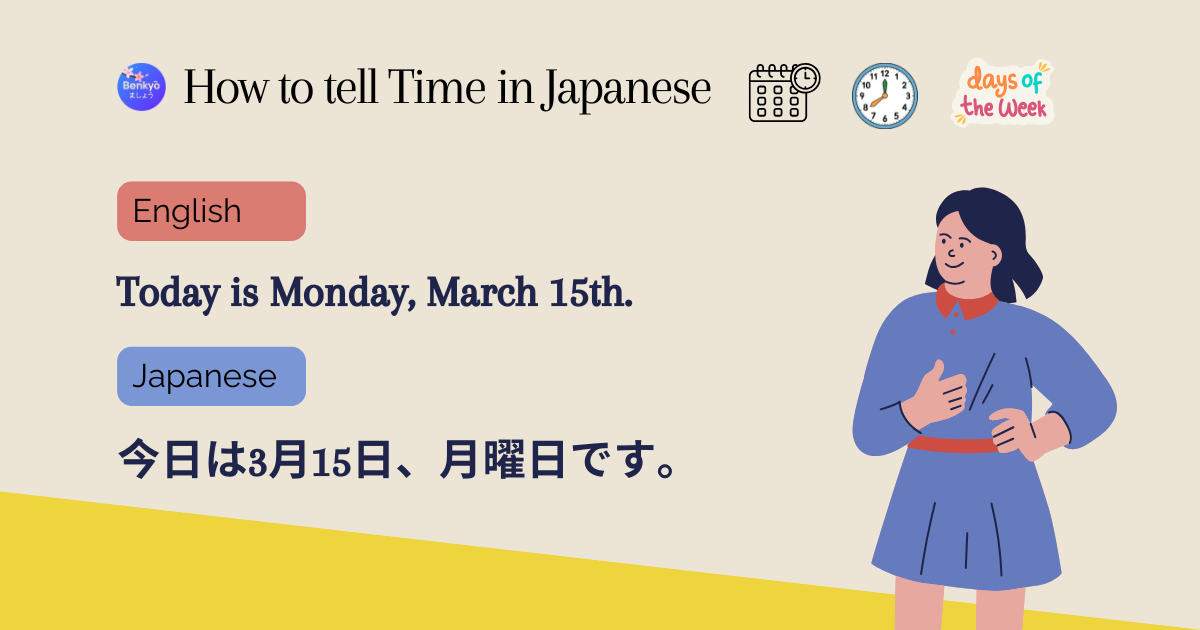
今日は月曜日です。
Kyō wa getsuyōbi desu.
"Today is Monday."
Making plans:
金曜日に会いましょう。
Kin'yōbi ni aimashō.
"Let's meet on Friday."
Casual Shorthand: In casual writing (texts, calendars), Japanese often drops the 曜日 and just uses the element kanji: 月 (Monday), 火 (Tuesday), 水 (Wednesday), etc. You'll see this on train schedules, calendars, and smartphones!
Months of the Year
Japanese months are beautifully simple. They're literally numbered 1 through 12 with 月 (gatsu) attached.
The Twelve Months
| Month | Kanji | Reading |
|---|---|---|
| January | 一月 | ichigatsu |
| February | 二月 | nigatsu |
| March | 三月 | sangatsu |
| April | 四月 | shigatsu |
| May | 五月 | gogatsu |
| June | 六月 | rokugatsu |
| July | 七月 | shichigatsu |
| August | 八月 | hachigatsu |
| September | 九月 | kugatsu |
| October | 十月 | jūgatsu |
| November | 十一月 | jūichigatsu |
| December | 十二月 | jūnigatsu |
Important Notes
Special readings to watch:
- April: し月 (shigatsu), not よん月
- July: しち月 (shichigatsu), not なな月
- September: く月 (kugatsu), not きゅう月
These follow the most common readings, though you might occasionally hear alternatives in different contexts.
Using Months in Sentences
Asking about months:
誕生日は何月ですか?
Tanjōbi wa nangatsu desu ka?
"What month is your birthday?"
Answering:
三月です。
Sangatsu desu.
"It's March."
Describing seasons:
日本では、三月から五月まで春です。
Nihon dewa, sangatsu kara gogatsu made haru desu.
"In Japan, it's spring from March to May."
Dates and Days of the Month
This is where Japanese gets tricky. The first 10 days have irregular readings, and certain other dates follow special patterns.
Days 1-10 (Irregular Readings)
| Day | Kanji | Reading |
|---|---|---|
| 1st | 一日 | tsuitachi |
| 2nd | 二日 | futsuka |
| 3rd | 三日 | mikka |
| 4th | 四日 | yokka |
| 5th | 五日 | itsuka |
| 6th | 六日 | muika |
| 7th | 七日 | nanoka |
| 8th | 八日 | yōka |
| 9th | 九日 | kokonoka |
| 10th | 十日 | tōka |
Memory Aid: These irregular readings come from the old Japanese counting system (ひとつ、ふたつ、みっつ, etc.). Notice: ふたつ → ふつか, みっつ → みっか, よっつ → よっか
Days 11-31
From the 11th onwards, most days follow a more regular pattern: number + 日 (nichi)
| Day | Kanji | Reading |
|---|---|---|
| 11th | 十一日 | jūichinichi |
| 14th | 十四日 | jūyokka* |
| 15th | 十五日 | jūgonichi |
| 20th | 二十日 | hatsuka* |
| 24th | 二十四日 | nijūyokka* |
| 31st | 三十一日 | sanjūichinichi |
Special irregular dates marked with * :
- 14th: じゅうよっか (not じゅうよんにち)
- 20th: はつか (not にじゅうにち)
- 24th: にじゅうよっか (not にじゅうよんにち)
Saying Full Dates
Pattern: Year + Month + Date
二千二十五年三月十五日
Nisen-nijūgo-nen sangatsu jūgonichi
"March 15, 2025"
Casual version (often drops year):
三月十五日
Sangatsu jūgonichi
"March 15th"
Asking About Dates
今日は何月何日ですか?
Kyō wa nangatsu nannichi desu ka?
"What's today's date?"
誕生日はいつですか?
Tanjōbi wa itsu desu ka?
"When is your birthday?"
Relative Time Expressions
These are the words you'll use constantly in conversation.
Basic Time Words
| English | Kanji | Reading |
|---|---|---|
| today | 今日 | kyō |
| yesterday | 昨日 | kinō |
| tomorrow | 明日 | ashita |
| the day before yesterday | 一昨日 | ototoi |
| the day after tomorrow | 明後日 | asatte |
| this week | 今週 | konshū |
| last week | 先週 | senshū |
| next week | 来週 | raishū |
| this month | 今月 | kongetsu |
| last month | 先月 | sengetsu |
| next month | 来月 | raigetsu |
| this year | 今年 | kotoshi |
| last year | 去年 | kyonen |
| next year | 来年 | rainen |
Pattern Recognition
Notice the patterns:
今 (kon/kyo) = this
今日 (today), 今週 (this week), 今月 (this month), 今年 (this year)
先 (sen) = last/previous
先週 (last week), 先月 (last month)
来 (rai) = next/coming
来週 (next week), 来月 (next month), 来年 (next year)
More Relative Time
いつ (itsu) - when
今 (ima) - now
さっき (sakki) - just now, a moment ago
あとで (ato de) - later
もうすぐ (mōsugu) - soon
すぐに (sugu ni) - right away, immediately
Time Duration vs. Points in Time
This is crucial: Japanese distinguishes between a point in time and a duration of time.
Points in Time (Use に)
三時に会いましょう。
Sanji ni aimashō.
"Let's meet at 3 o'clock."
月曜日に行きます。
Getsuyōbi ni ikimasu.
"I'm going on Monday."
Duration of Time (No particle or を)
三時間勉強しました。
Sanjikan benkyō shimashita.
"I studied for three hours."
一週間待ちました。
Isshūkan machimashita.
"I waited for one week."
Duration Counters
〜時間 (jikan) - hours (duration)
〜分間 (funkan) - minutes (duration)
〜日間 (nichikan) - days (duration)
〜週間 (shūkan) - weeks (duration)
〜ヶ月 (kagetsu) - months (duration)
〜年間 (nenkan) - years (duration)
Key Distinction: 三時 (sanji) = 3 o'clock (point in time)
三時間 (sanjikan) = 3 hours (duration)
三月 (sangatsu) = March (month name)
三ヶ月 (sankagetsu) = 3 months (duration)
Common Time-Related Particles
に - Specific time point
Marks the exact moment when something happens.
七時に起きます。
Shichiji ni okimasu.
"I wake up at 7 o'clock."
月曜日に会議があります。
Getsuyōbi ni kaigi ga arimasu.
"There's a meeting on Monday."
Exception: Relative time words like 今日 (today), 明日 (tomorrow), 昨日 (yesterday) don't use に in casual speech.
今日行きます。(not 今日に)
Kyō ikimasu.
"I'll go today."
から - From (starting point)
午前九時から仕事です。
Gozen kuji kara shigoto desu.
"I work from 9 AM."
まで - Until, up to (ending point)
午後五時まで働きます。
Gogo goji made hatarakimasu.
"I work until 5 PM."
から...まで - From...to
月曜日から金曜日まで学校があります。
Getsuyōbi kara kin'yōbi made gakkō ga arimasu.
"I have school from Monday to Friday."
ごろ / ぐらい - Around, approximately
ごろ - approximate point in time
ぐらい - approximate duration
三時ごろ帰ります。
Sanji goro kaerimasu.
"I'll return around 3 o'clock."
二時間ぐらいかかります。
Nijikan gurai kakarimasu.
"It takes about 2 hours."
Real-World Conversation Examples
Making Plans
A: 明日、何時に会いましょうか?
Ashita, nanji ni aimashō ka?
"What time shall we meet tomorrow?"
B: 午後二時はどうですか?
Gogo niji wa dō desu ka?
"How about 2 PM?"
A: いいですね。じゃあ、二時に駅で。
Ii desu ne. Jā, niji ni eki de.
"Sounds good. Then at 2 o'clock at the station."
At Work
Manager: この資料、いつまでに必要ですか?
Kono shiryō, itsu made ni hitsuyō desu ka?
"By when do you need these materials?"
You: 金曜日までにお願いします。
Kin'yōbi made ni onegai shimasu.
"By Friday, please."
Scheduling an Appointment
Receptionist: ご予約は何月何日がよろしいでしょうか?
Go-yoyaku wa nangatsu nannichi ga yoroshii deshō ka?
"What date would work for your appointment?"
You: 来週の水曜日、午前十時はどうですか?
Raishū no suiyōbi, gozen jūji wa dō desu ka?
"How about next Wednesday at 10 AM?"
At a Restaurant
Waiter: ご予約の時間は?
Go-yoyaku no jikan wa?
"What time is your reservation?"
You: 七時半です。
Shichiji han desu.
"7:30."
Talking About Your Daily Routine
Friend: 毎朝、何時に起きますか?
Maiasa, nanji ni okimasu ka?
"What time do you wake up every morning?"
You: だいたい六時ごろです。
Daitai rokuji goro desu.
"Around 6 o'clock usually."
Friend: 仕事は何時からですか?
Shigoto wa nanji kara desu ka?
"What time does work start?"
You: 九時からです。八時間働きます。
Kuji kara desu. Hachijikan hatarakimasu.
"From 9 o'clock. I work 8 hours."
Discussing How Long Something Takes
A: ここから空港まで、どのくらいかかりますか?
Koko kara kūkō made, dono kurai kakarimasu ka?
"How long does it take from here to the airport?"
B: 電車で一時間ぐらいです。
Densha de ichijikan gurai desu.
"About an hour by train."
Talking About Past Events
A: 昨日の映画、どうでしたか?
Kinō no eiga, dō deshita ka?
"How was yesterday's movie?"
B: とてもよかったです!三時間もあったけど、あっという間でした。
Totemo yokatta desu! Sanjikan mo atta kedo, atto iu ma deshita.
"It was really good! It was 3 hours long, but it flew by."
Advanced Time Expressions
Frequency Expressions
毎日 (mainichi) - every day
毎週 (maishū) - every week
毎月 (maitsuki) - every month
毎年 (maitoshi) - every year
毎朝 (maiasa) - every morning
毎晩 (maiban) - every night
毎朝、ジョギングをします。
Maiasa, jogingu o shimasu.
"I jog every morning."
Counters for Times (Occurrences)
〜回 (kai) - times, occurrences
一回 (ikkai) - once
二回 (nikai) - twice
三回 (sankai) - three times
週に三回、ジムに行きます。
Shū ni sankai, jimu ni ikimasu.
"I go to the gym three times a week."
Period Expressions
〜前 (mae) - ago
〜後 (go/ato) - after, later
三日前
Mikka mae
"Three days ago"
二時間後
Nijikan go
"Two hours later"
Vague Time Expressions
最近 (saikin) - recently, lately
このごろ (kono goro) - these days
この間 (kono aida) - the other day
いつか (itsuka) - someday
いつも (itsumo) - always
たまに (tama ni) - occasionally
時々 (tokidoki) - sometimes
最近、忙しいです。
Saikin, isogashii desu.
"I've been busy lately."
Seasonal Time
春 (haru) - spring
夏 (natsu) - summer
秋 (aki) - fall/autumn
冬 (fuyu) - winter
春に桜を見に行きたいです。
Haru ni sakura o mi ni ikitai desu.
"I want to go see cherry blossoms in spring."
Common Mistakes to Avoid
Using に with Relative Time Words
Wrong: 今日に行きます
Correct: 今日行きます (no particle)
Why: Relative time words (今日, 明日, 昨日, etc.) typically don't take に in casual speech.
Confusing Time Point vs. Duration
Wrong: 三時勉強しました (means "I studied at 3 o'clock")
Correct: 三時間勉強しました ("I studied for 3 hours")
Mixing Up しち and よん
Wrong: 四時 (shiji)
Correct: 四時 (yoji) for 4 o'clock
Why: 4 o'clock uses よ reading to avoid confusion with 死 (death).
Forgetting Half Past
Awkward: 三時三十分
More Natural: 三時半 (sanji han)
Why: Using 半 for "half past" is more natural and common.
Date Order Confusion
English Order: March 15, 2025
Japanese Order: 2025年三月十五日
Pattern: Year → Month → Day (largest to smallest)
Mixing Up Minutes Readings
Remember: ぷん after 1, 3, 4, 6, 8, 10 and ふん after 2, 5, 7, 9
五分 (gofun) ✓
六分 (roppun) ✓
Practice Exercises
Exercise 1: Days and Dates
Translate to Japanese:
- "What day is today?"
- "Today is Wednesday."
- "My birthday is March 5th."
Exercise 2: Telling Time
Write in Japanese:
- 7:30 AM
- 9:45 PM
- "What time is it now?"
Exercise 3: Duration vs. Point in Time
Choose the correct form:
- I studied for 2 hours: 二時 or 二時間?
- Let's meet at 3 o'clock: 三時に or 三時間に?
- It takes 30 minutes: 三十分 or 三十分間?
Exercise 4: Real Conversation
Translate this dialogue:
A: "When are you free next week?"
B: "I'm free on Thursday afternoon."
A: "How about 2:30 PM?"
B: "Sounds good!"
Check Your Answers
Exercise 1:
- 今日は何曜日ですか?
- 今日は水曜日です。
- 私の誕生日は三月五日です。
Exercise 2:
- 午前七時半
- 午後九時四十五分 (or 21:45 in 24-hour time)
- 今、何時ですか?
Exercise 3:
- 二時間 (duration)
- 三時に (point in time)
- 三十分 (duration - 分間 is optional)
Exercise 4:
A: 来週、いつ暇ですか?
B: 木曜日の午後、暇です。
A: 午後二時半はどうですか?
B: いいですね!
Wrapping Up: Mastering Japanese Time
Time expressions in Japanese might seem overwhelming at first, but they follow logical patterns. Here's what makes the system work:
The Bottom Line:
- Days and months are numbered - Once you know the numbers, you know the months
- Irregular readings exist but are limited - Mostly in the first 10 days and certain times
- Distinguish duration from point in time - 時 vs. 時間 matters!
- Particles matter - に for specific times, no particle for relative times
- Half past is special - Use 半 instead of saying 30 minutes
Most Important Patterns to Remember:
- Days: Number + 曜日
- Months: Number + 月
- Dates: 1-10 are irregular, then mostly regular
- Hours: Number + 時
- Minutes: Watch for ふん/ぷん changes
- Duration: Add 間 (kan) to show duration
Practice Tips:
- Use your daily routine - Practice saying when you do things every day
- Read train schedules - Great real-world practice for times
- Make plans in Japanese - Even if just with yourself, practice scheduling
- Check Japanese calendars - Get familiar with the date format
The more you use time expressions in real contexts, the more natural they become. Before long, you'll be making plans and telling time in Japanese without having to think about the rules at all.
Ready to level up your Japanese?
- Japanese Numbers 1 to 100 and Beyond: The two counting systems behind every time expression, and why 4, 7 and 9 have two readings
- Japanese Counter Words Guide: Master counting everything from pencils to rabbits
- Complete Lessons Section: Structured practice from N5 to N4
頑張って!(Ganbatte! - Good luck with your studies!)