
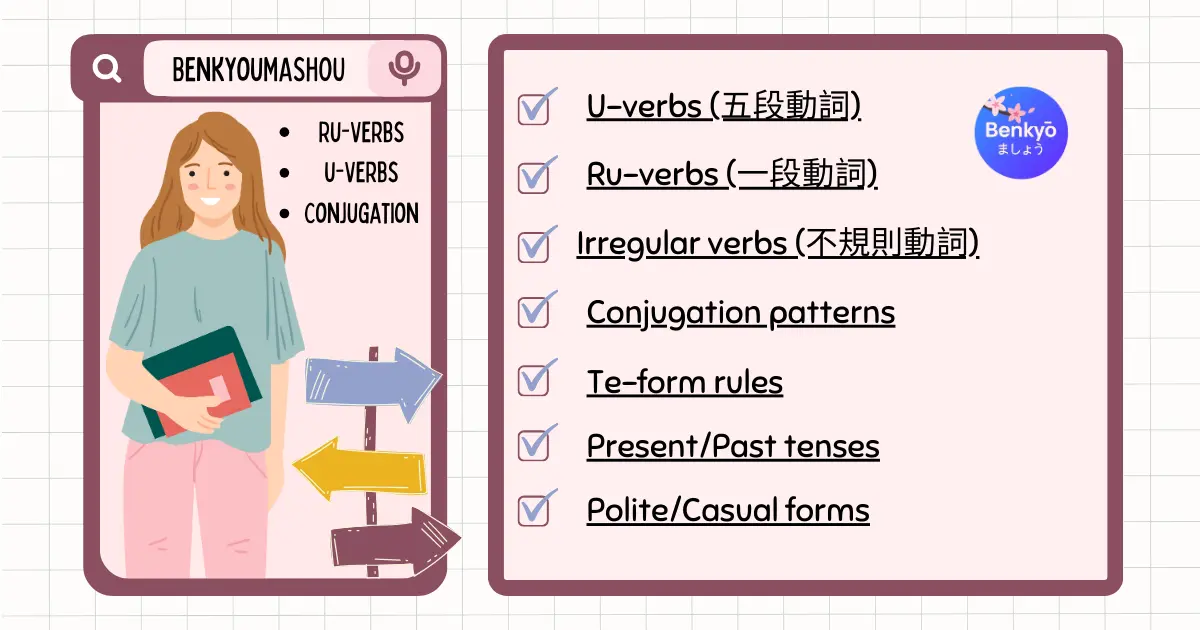
Table of Contents
Introduction to Japanese Verb Conjugation
Japanese verb conjugation might seem intimidating at first, but it's actually more straightforward than you think. Unlike English or Romance languages, Japanese verbs don't change based on who's doing the action. Whether it's "I eat," "you eat," or "they eat," the verb form remains the same!
Japanese has only three verb groups and follows consistent patterns with very few irregular verbs. Once you master these patterns, you can conjugate any Japanese verb with confidence. Check out our 300+ verb database for practice.
Key Benefits of Mastering Verb Conjugation:
- Express different tenses (present, past, future)
- Show politeness levels appropriately
- Create complex sentences with multiple actions
- Sound natural in conversations
The Three Verb Groups
All Japanese verbs fall into one of three categories. Understanding which group a verb belongs to is crucial for proper conjugation.
Group 1: U-verbs (Godan Verbs / 五段動詞)
U-verbs are called "godan" (five-step) because they use all five vowel sounds when conjugating. These verbs end in various consonant + う sounds.
| Ending | Example | English |
|---|---|---|
| 〜む | 読む (yomu) | to read |
| 〜く | 書く (kaku) | to write |
| 〜す | 話す (hanasu) | to speak |
| 〜つ | 待つ (matsu) | to wait |
| 〜ぬ | 死ぬ (shinu) | to die |
| 〜ぶ | 呼ぶ (yobu) | to call |
| 〜ぐ | 泳ぐ (oyogu) | to swim |
| 〜る* | 帰る (kaeru) | to return |
*Some verbs ending in る are actually U-verbs, not Ru-verbs.
Group 2: Ru-verbs (Ichidan Verbs / 一段動詞)
Ru-verbs are much simpler to conjugate. They end in る preceded by an い or え sound.
| Pattern | Example | English |
|---|---|---|
| 〜える | 食べる (taberu) | to eat |
| 〜いる | 見る (miru) | to see |
| 〜ける | 開ける (akeru) | to open |
| 〜きる | 起きる (okiru) | to wake up |
| 〜ねる | 寝る (neru) | to sleep |
Group 3: Irregular Verbs
Good news! There are only two irregular verbs in Japanese:
- する (suru) - to do
- 来る (kuru) - to come
Many compound verbs use する, such as:
- 勉強する (benkyou suru) - to study
- 仕事する (shigoto suru) - to work
- 料理する (ryouri suru) - to cook
Tricky る-ending U-verbs
Some verbs end in る but are actually U-verbs. These are exceptions you need to memorize:
| Verb | Reading | English |
|---|---|---|
| 帰る | kaeru | to return |
| 走る | hashiru | to run |
| 入る | hairu | to enter |
| 知る | shiru | to know |
| 切る | kiru | to cut |
| 要る | iru | to need |
Essential Conjugation Forms
Let's start with the most important conjugation forms that you'll use in everyday Japanese.
Present/Future Forms
Polite Form (〜ます)
The ます form is used in formal situations and when showing respect or politeness.
| Verb Type | Rule | Example |
|---|---|---|
| U-verbs | Change う sound → い sound + ます | 読む → 読みます |
| Ru-verbs | Remove る + ます | 食べる → 食べます |
| する | Irregular | する → します |
| 来る | Irregular | 来る → 来ます |
Plain Form (Dictionary Form)
This is the casual form used in informal situations and is the base form found in dictionaries.
Negative Forms
Plain Negative (〜ない)
| Verb Type | Rule | Example |
|---|---|---|
| U-verbs | Change う sound → あ sound + ない | 読む → 読まない |
| Ru-verbs | Remove る + ない | 食べる → 食べない |
| する | Irregular | する → しない |
| 来る | Irregular | 来る → 来ない |
Polite Negative (〜ません)
Simply change ます to ません:
- 読みます → 読みません
- 食べます → 食べません
Past Forms
Past tense forms express completed actions.
Polite Past (〜ました)
- 読みます → 読みました
- 食べます → 食べました
Plain Past (Ta-form)
This follows the same rules as te-form but with た/だ instead of て/で.
Te-form and Ta-form Rules
The te-form is one of the most important conjugations in Japanese. It's used to connect sentences, make requests, and form continuous tenses.
Ta-form Rules (Past Tense)
Learn the ta-form first, then convert た→て and だ→で for te-form.
| Ending | Ta-form Rule | Example | Te-form |
|---|---|---|---|
| う・つ・る | → った | 買う → 買った | 買って |
| む・ぶ・ぬ | → んだ | 読む → 読んだ | 読んで |
| く | → いた | 書く → 書いた | 書いて |
| ぐ | → いだ | 泳ぐ → 泳いだ | 泳いで |
| す | → した | 話す → 話した | 話して |
| 行く | → 行った (exception!) | 行く → 行った | 行って |
Ru-verbs and Irregular Verbs
| Verb Type | Ta-form | Te-form |
|---|---|---|
| Ru-verbs | Remove る + た | Remove る + て |
| する | した | して |
| 来る | 来た | 来て |
Te-form Usage
The te-form has many important uses:
1. Continuous Actions (〜ている)
- 食べている - "eating" (ongoing action)
- 住んでいる - "living" (current state)
2. Requests (〜てください)
- 手伝ってください - "Please help"
- ゆっくり話してください - "Please speak slowly"
3. Connecting Actions
- 朝ごはんを食べて学校に行きます - "I eat breakfast and go to school"
Advanced Conjugation Forms
Volitional Form (Let's / I will)
Used to express intention or suggest doing something together.
| Verb Type | Rule | Example |
|---|---|---|
| U-verbs | Change う → お + う | 読む → 読もう |
| Ru-verbs | Remove る + よう | 食べる → 食べよう |
| する | しよう | 勉強しよう |
| 来る | 来よう | こよう |
Examples:
- 映画を見よう - "Let's watch a movie"
- 一緒に勉強しよう - "Let's study together"
Potential Form (Can do)
Expresses ability or possibility.
| Verb Type | Rule | Example |
|---|---|---|
| U-verbs | Change to え column + る | 読む → 読める |
| Ru-verbs | Remove る + られる | 食べる → 食べられる |
| する | できる | 勉強する → 勉強できる |
| 来る | 来られる | こられる |
Particle Change:
With potential form, を becomes が:
- 漢字を読む → 漢字が読める
- 寿司を食べる → 寿司が食べられる
Conditional Forms
〜たら (If/When)
Take the ta-form and add ら:
- 読んだら - "if you read"
- 食べたら - "if you eat"
- 雨が降ったら家にいます - "If it rains, I'll stay home"
〜ば (If)
Change to え column + ば:
- 読めば - "if you read"
- 食べれば - "if you eat"
Desire Form (〜たい)
Expresses wants and desires. Change ます → たい. For a detailed guide on using tai-form, check out our Complete tai-form tutorial
- 読みます → 読みたい - "want to read"
- 食べます → 食べたい - "want to eat"
- 日本に行きたいです - "I want to go to Japan"
Important:
Use 〜たい only for your own desires. For others, use 〜たがっている:
彼は帰りたがっています - "He wants to go home"
Passive Form
Expresses that something is done to the subject.
| Verb Type | Rule | Example |
|---|---|---|
| U-verbs | Change to あ column + れる | 読む → 読まれる |
| Ru-verbs | Remove る + られる | 食べる → 食べられる |
| する | される | 勉強する → 勉強される |
| 来る | 来られる | こられる |
Causative Form
Expresses making or letting someone do something.
| Verb Type | Rule | Example |
|---|---|---|
| U-verbs | Change to あ column + せる | 読む → 読ませる |
| Ru-verbs | Remove る + させる | 食べる → 食べさせる |
| する | させる | 勉強する → 勉強させる |
| 来る | 来させる | こさせる |
Examples:
- 子供に野菜を食べさせる - "Make the child eat vegetables"
- 学生に宿題をさせる - "Make students do homework"
Complete Conjugation Tables
U-verb Example: 読む (yomu - to read)
| Form | Japanese | English |
|---|---|---|
| Present (polite) | 読みます | read/will read |
| Present (plain) | 読む | read/will read |
| Negative (plain) | 読まない | don't read |
| Past (plain) | 読んだ | read (past) |
| Te-form | 読んで | reading/and read |
| Volitional | 読もう | let's read |
| Potential | 読める | can read |
| Desire | 読みたい | want to read |
| Conditional | 読んだら | if you read |
| Passive | 読まれる | is read |
| Passive | 読まれる | is read |
| Causative | 読ませる | make/let read |
Ru-verb Example: 食べる (taberu - to eat)
| Form | Japanese | English |
|---|---|---|
| Present (polite) | 食べます | eat/will eat |
| Present (plain) | 食べる | eat/will eat |
| Negative (plain) | 食べない | don't eat |
| Past (plain) | 食べた | ate |
| Te-form | 食べて | eating/and eat |
| Volitional | 食べよう | let's eat |
| Potential | 食べられる | can eat |
| Desire | 食べたい | want to eat |
| Conditional | 食べたら | if you eat |
| Passive | 食べられる | is eaten |
| Causative | 食べさせる | make/let eat |
Quick Comparison: All Groups
| Form | U-verb (読む) | Ru-verb (食べる) | する | 来る |
|---|---|---|---|---|
| Present polite | 読みます | 食べます | します | 来ます |
| Negative | 読まない | 食べない | しない | 来ない |
| Past | 読んだ | 食べた | した | 来た |
| Te-form | 読んで | 食べて | して | 来て |
| Potential | 読める | 食べられる | できる | 来られる |
| Volitional | 読もう | 食べよう | しよう | 来よう |
Common Mistakes to Avoid
1. Confusing Verb Groups
Many learners assume all verbs ending in る are Ru-verbs. Remember the exceptions!
Wrong:
帰る is a Ru-verb → 帰ます
Correct:
帰る is a U-verb → 帰ります
2. Te-form Formation Errors
Don't memorize te-forms individually. Learn the ta-form rules and convert.
Wrong:
Memorizing 食べて, 飲んで, 書いて separately
Correct:
Learn ta-form patterns, then convert た→て, だ→で
3. Mixing Up Potential and Passive
For Ru-verbs, potential and passive forms look identical but have different meanings.
- Potential: 寿司が食べられる - "can eat sushi"
- Passive: 寿司が食べられた - "sushi was eaten"
4. Using たい Incorrectly for Others
Don't use たい when talking about what others want.
Awkward:
彼は帰りたいです
Natural:
彼は帰りたがっています
5. Forgetting Particle Changes
Some conjugations require particle changes:
- Potential form: を → が
- Desire form: を can become が
Real-World Application Examples
Daily Routine Description
Practice conjugating verbs while describing your day:
Morning Routine:
- 朝7時に起きます (I wake up at 7 AM)
- シャワーを浴びて朝ごはんを食べます (I take a shower and eat breakfast)
- 8時に家を出て電車に乗ります (I leave home at 8 and take the train)
Making Plans
Use different conjugations when planning activities:
Weekend Plans:
- 映画を見たいです (I want to watch a movie)
- 友達と一緒に買い物しましょう (Let's go shopping with friends)
- 雨が降ったら家にいます (If it rains, I'll stay home)
Expressing Abilities and Preferences
Talking About Skills:
- 日本語が少し話せます (I can speak Japanese a little)
- 料理するのが好きです (I like cooking)
- 泳ぐことができません (I can't swim)
Conclusion
Japanese verb conjugation might seem overwhelming at first, but it's actually quite systematic. With only three verb groups and consistent patterns, you can master the majority of Japanese verbs once you understand the rules.
Remember these key points:
- Identify the verb group first (U-verb, Ru-verb, or irregular)
- Learn basic forms before advancing to complex ones
- Practice with real sentences, not just tables
- Use memory aids and consistent study methods
- Don't rush - master each form thoroughly before moving on
The beauty of Japanese verb conjugation lies in its logical patterns. Unlike English, where irregular verbs are numerous and unpredictable, Japanese follows clear rules that apply consistently across thousands of verbs.
Start with the essential forms (present, past, negative, te-form) and gradually build up to the advanced forms. With consistent practice and the right study methods, you'll soon find yourself conjugating Japanese verbs naturally and confidently.
Ready to Practice More Verbs?
Explore our comprehensive database of 300+ Japanese verbs with detailed conjugations and examples.
Browse All Japanese VerbsSpeak Japanese from Day 1
Want to dive deeper into Japanese grammar and speak Japanese fluently?