
The first time I ordered food in Japan, I confidently said 「私はラーメン」 (Watashi wa rāmen). The waiter nodded, but something felt... off. I had said "As for me, ramen," which wasn't wrong, but it wasn't what a native speaker would say.
That's Japanese particles for you. They're the small words that turn disconnected vocabulary into natural sentences. Ignore them, and you'll always sound like a textbook. Master them, and you start to think in Japanese.
The key isn't memorizing rules—it's understanding what each particle actually does in the sentence.
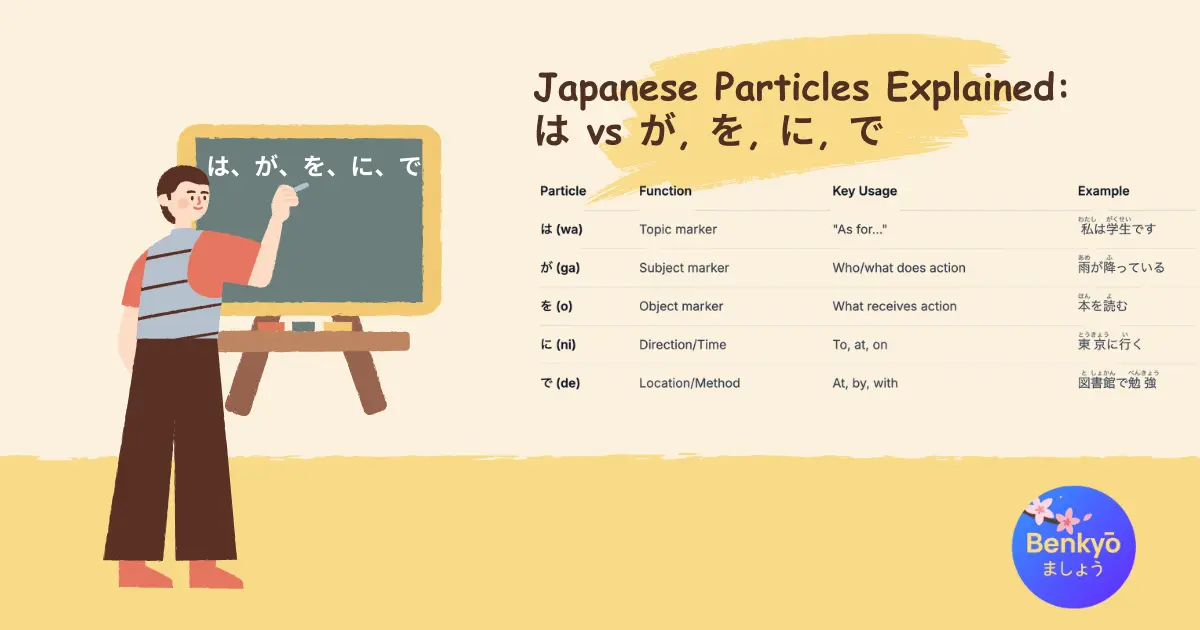
Quick Reference Guide
| Particle | Function | Key Usage | Example |
|---|---|---|---|
| は (wa) | Topic marker | "As for..." | 私は学生です |
| が (ga) | Subject marker | Who/what does action | 雨が降っている |
| を (o) | Object marker | What receives action | 本を読む |
| に (ni) | Direction/Time | To, at, on | 東京に行く |
| で (de) | Location/Method | At, by, with | 図書館で勉強 |
Table of Contents
- What Are Japanese Particles?
- は (wa) - The Topic Marker
- が (ga) - The Subject Marker
- は vs が - Which One to Use?
- を (o) - The Direct Object Marker
- に (ni) - The Pinpoint Particle
- で (de) - The Context Particle
- Common Particle Mistakes
- Real Conversation Examples
What Are Japanese Particles?
In English, word order matters: "Dog bites man" is very different from "Man bites dog."
Japanese uses particles to show relationships between words, giving you much more flexibility with word order. Think of particles as little tags that tell you each word's job in the sentence.
犬が人を噛みました (inu ga hito o kamimashita)
人を犬が噛みました (hito o inu ga kamimashita)
The particles が (subject) and を (object) make both sentences mean "The dog bit the man." Same meaning, different word order.
は (wa) - The Topic Marker
Important: Written as は but pronounced "wa"
Think of は as setting the conversation topic. It's like saying "Speaking of..." or "As for..." in English.
Basic Usage
私は学生です。
Watashi wa gakusei desu.
"Speaking of me, I am a student"
今日は暑いですね。
Kyō wa atsui desu ne.
"As for today, it's hot"
Contrast and Emphasis
は often creates subtle contrasts. When you say A は B, you're hinting that something else might not be B.
ビールは飲みますが、ワインは飲みません。
Bīru wa nomimasu ga, wain wa nomimasen.
"I drink beer, but I don't drink wine."
The は particles highlight the contrast between beer and wine.
が (ga) - The Subject Marker
If は sets the topic, が identifies the specific actor. It points to who or what is actually doing something or being described.
Basic Usage
雨が降っています。
Ame ga futte imasu.
"Rain is falling"
猫がいます。
Neko ga imasu.
"There is a cat"
New Information Focus
が introduces new, specific information, especially when answering questions.
誰が来ましたか?
Dare ga kimashita ka?
"Who came?"
山田さんが来ました。
Yamada-san ga kimashita.
"Yamada-san came."
With Descriptive Sentences
When describing something you observe, use が.
このケーキが美味しいです。
Kono kēki ga oishii desu.
"This cake is delicious."
は vs が - Which One to Use?
The difference is about information flow. は introduces familiar topics, が identifies specific new information.
Compare These Examples:
象は鼻が長いです。
Zō wa hana ga nagai desu.
"As for elephants, their noses are long."
(Topic: elephants; New info: which part is long)
あ、象がいます!
A, zō ga imasu!
"Oh, there's an elephant!"
(Introducing completely new information)
Question and Answer Patterns
Who ate the cake?
誰がケーキを食べましたか?
Natural answer:
私が食べました。
"I did." (You're the specific new information)
Unnatural answer:
私は食べました。
"As for me, I ate." (Sounds like you're changing the topic)
Want more on は vs が?
We have a detailed guide with more examples, tricky cases and a decision framework.
Japanese Particles は vs が Explained
を (o) - The Direct Object Marker
Important: Written as を but pronounced "o"
を points to what receives the action of the verb.
Basic Usage
本を読みます。
Hon o yomimasu.
"(I) read a book."
映画を見ました。
Eiga o mimashita.
"(I) watched a movie."
水を飲んでください。
Mizu o nonde kudasai.
"Please drink water."
Movement Through or From a Place
を also marks spaces you move through or leave.
公園を散歩します。
Kōen o sanpo shimasu.
"(I) walk through the park."
家を出ます。
Ie o demasu.
"(I) leave the house."
に (ni) - The Pinpoint Particle
に marks specific targets: points in time, destinations, locations of existence, or purposes.
Time (Specific Points)
三時に会いましょう。
San-ji ni aimashou.
"Let's meet at 3 o'clock."
日曜日に出かけます。
Nichiyōbi ni dekakemasu.
"(I) go out on Sunday."
Note: Don't use に with relative time words like 今日 (today) or 明日 (tomorrow).
Direction and Destination
大阪に行きます。
Ōsaka ni ikimasu.
"(I) am going to Osaka."
Purpose (With Motion Verbs)
買い物に行きます。
Kaimono ni ikimasu.
"(I) go shopping."
Existence Location
に marks where something exists.
テーブルの下に猫がいます。
Tēburu no shita ni neko ga imasu.
"There is a cat under the table."
で (de) - The Context Particle
で provides context—where actions happen or how they're performed.
Action Location
図書館で勉強します。
Toshokan de benkyō shimasu.
"(I) study at the library."
カフェで話しました。
Kafe de hanashimashita.
"(We) talked at a café."
Method and Means
バスで行きます。
Basu de ikimasu.
"(I) go by bus."
日本語で話しましょう。
Nihongo de hanashimashou.
"Let's speak in Japanese."
Scope or Total
三人で行きます。
San-nin de ikimasu.
"(We) will go as a group of three."
千円で買いました。
Sen-en de kaimashita.
"(I) bought (it) for 1000 yen."
Common Particle Mistakes (And How to Avoid Them)
Confusing に and で for Location
The key difference: Existence vs. Action.
Wrong: 図書館に勉強します。
Right: 図書館で勉強します。
(You perform the action of studying at the library)
Wrong: 図書館で本がたくさんあります。
Right: 図書館に本がたくさんあります。
(The books exist in the library)
Need more help with に vs で? Check out our detailed guide with decision frameworks and tricky cases.
Japanese Particles に vs で Location Guide
The 「好き (suki)」 Trap
In English: "I like dogs" (I = subject, dogs = object)
In Japanese: 犬が好きです (dogs = subject of "being likeable")
Wrong: 私は犬を好きです。
Right: 私は犬が好きです。
Answering Questions with the Wrong Particle
Q: 誰が飲み物を持ってきましたか? (Who brought the drinks?)
Natural: マリアさんが持ってきました。
Awkward: マリアさんは持ってきました。
Real Conversation Examples
At a Café
A: ご注文は何にしますか?
Go-chūmon wa nani ni shimasu ka?
"What will you order?"
B: 私はコーヒーを一つお願いします。田中さんは?
Watashi wa kōhii o hitotsu onegaishimasu. Tanaka-san wa?
"I'll have one coffee, please. How about you, Tanaka-san?"
A: このケーキが美味しそうですね。これにします。
Kono kēki ga oishisō desu ne. Kore ni shimasu.
"This cake looks delicious. I'll have this."
Planning Weekend Activities
A: 土曜日に映画を見に行きませんか?
Doyōbi ni eiga o mi ni ikimasen ka?
"Would you like to go see a movie on Saturday?"
B: いいですね!どこで見ますか?
Ii desu ne! Doko de mimasu ka?
"That sounds good! Where shall we watch it?"
A: 新宿の映画館はどうですか?電車で簡単に行けます。
Shinjuku no eigakan wa dō desu ka? Densha de kantan ni ikemasu.
"How about the movie theater in Shinjuku? We can get there easily by train."
The Bottom Line
Particles aren't just grammar rules to memorize—they're how Japanese speakers organize their thoughts. Once you start feeling the differences between は and が, or に and で, your Japanese will sound much more natural.
The secret is consistent practice with real sentences. Your brain picks up patterns naturally when you see them used correctly over and over.
Our complete Japanese particles guide series:
- Part 1: Essential Particles は・が・を・に・で — You just completed this foundation guide!
- Part 2: は vs が Detailed Guide — Conquer the most confusing particle pair
- Part 3: に vs で Location Guide — Never mix up location particles again
- Part 4: Everyday Particles と・から・まで・よ — Natural conversation essentials
With the basics in place, the next step is digging into the subtle distinctions that move you beyond intermediate.
Keep practicing, and soon particles will feel automatic.
頑張って!(Ganbatte!)
Practice Individual Particles
Want to study each particle in depth with practice questions? Check out our dedicated grammar guides:
- は Particle (Topic Marker) — When to use は and what it really means
- が Particle (Subject Marker) — Marking subjects and new information
- を Particle (Object Marker) — Marking direct objects
- に Particle (Direction/Time/Location) — Destinations, times, and existence
- で Particle (Means/Location of Action) — Where actions happen and how