Three years into studying Japanese, I finally thought I had は and が figured out. Then a Japanese friend corrected me:
"Actually, you'd say 雨が降っている, not 雨は降っている."
"But why?" I asked.
He paused. "It just... sounds right."
That's は vs が for you. Even native speakers struggle to explain the difference, but they feel it instinctively. The good news? Once you understand the core principle, everything else falls into place.
The secret: は sets the conversation topic, が identifies specific new information.
This complete Japanese grammar particles guide explains the wa ga difference that confuses most beginners and intermediate learners.
Table of Contents
- Quick Answer: When to Use は vs が
- The Core Difference: Topic vs New Information
- When You MUST Use が (ga)
- When You MUST Use は (wa)
- The Tricky Cases: Same Sentence, Different Meaning
- The "Double Particle" Pattern
- Cultural and Stylistic Nuances
- Emotional and Emphasis Patterns
- Practical Decision Tree
- Common Mistakes to Avoid
- Practice Scenarios
- Beyond the Basics: Advanced Patterns
- Memory Techniques
- Real Conversation Examples
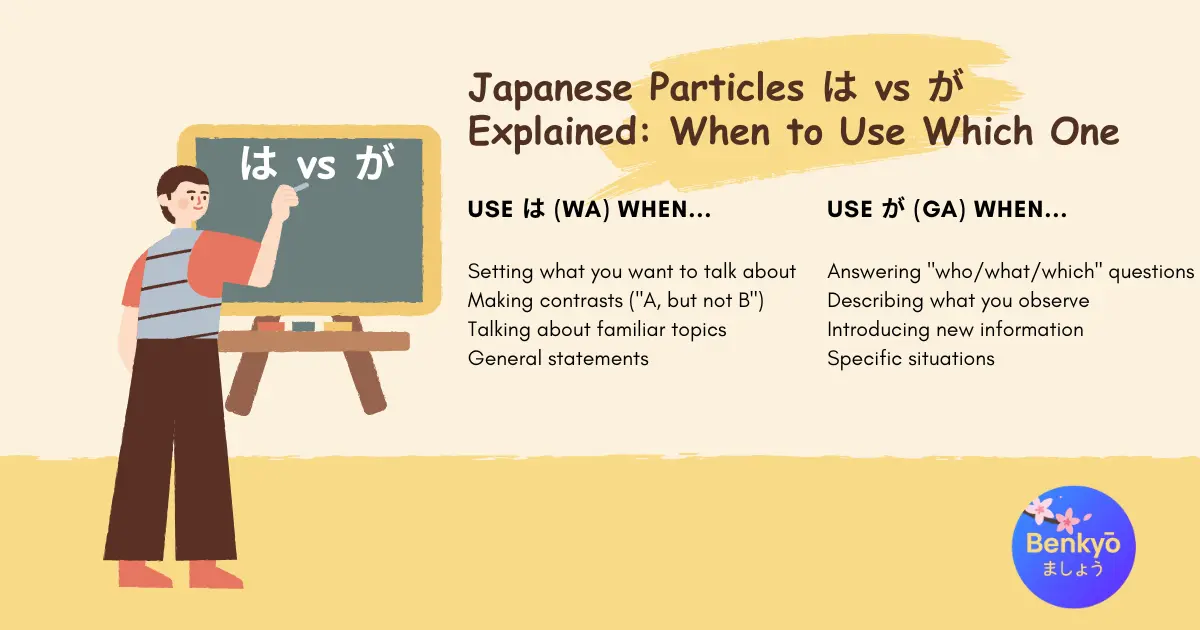
Quick Answer: When to Use は vs が
| Use は (wa) when... | Use が (ga) when... |
|---|---|
| Setting what you want to talk about | Answering "who/what/which" questions |
| Making contrasts ("A, but not B") | Describing what you observe |
| Talking about familiar topics | Introducing new information |
| General statements | Specific situations |
The Core Difference: Topic vs New Information
Think of は as a spotlight that illuminates the stage topic, and が as a pointing finger that says "this specific thing right here."
Theater Metaphor
Imagine a theater stage. は (wa) is like the stage lighting that sets the scene and tells you what play you're watching.
が (ga) is like a spotlight that suddenly focuses on one specific actor to highlight their important line.
は (wa) = "Speaking of..."
私は学生です。
Watashi wa gakusei desu.
"Speaking of me, I am a student."
今日は忙しいです。
Kyō wa isogashii desu.
"As for today, it's busy."
が (ga) = "This specific thing"
誰が来ましたか?
Dare ga kimashita ka?
"Who came?" (Which specific person?)
田中さんが来ました。
Tanaka-san ga kimashita.
"Tanaka-san came." (This specific person)
When You MUST Use が (ga)
1. Answering "Who/What/Which" Questions
When someone asks who, what, or which, your answer always uses が.
Q: 誰が料理しましたか?
A: 母が料理しました。
Q: 何が美味しいですか?
A: このケーキが美味しいです。
Grammar Note
The question asks for specific new information, so が points to that specific answer. In questions with 誰/何/どれ, use が (は is ungrammatical in normal questions).
2. Describing What You See/Observe
When you notice something happening right now, use が.
雨が降っています。
Ame ga futte imasu.
"It's raining." (You observe this happening now)
猫がいます。
Neko ga imasu.
"There's a cat." (You see it right there)
Observation Pattern
When describing immediate observations or discoveries, が emphasizes the "newness" of what you're seeing. This is why weather reports and "there is/are" statements typically use が. However, forecast headlines often use は to set "today/this area" as the topic.
3. With "Existence" Verbs (いる/ある)
図書館に本があります。
Toshokan ni hon ga arimasu.
"There are books in the library."
Usually が with ある/いる for neutral existence.
は is OK when contrasting or emphasizing:
図書館に本はあります
("There are books at the library, at least")
4. With Emotion/State Adjectives
Japanese treats emotions differently—the thing you like/want/understand becomes the subject with が.
私は犬が好きです。
Watashi wa inu ga suki desu.
"I like dogs." (Literally: "As for me, dogs are likeable")
お金が欲しいです。
Okane ga hoshii desu.
"I want money."
日本語が分かりません。
Nihongo ga wakarimasen.
"I don't understand Japanese."
Mind Shift
Japanese conceptualizes emotions differently than English. Instead of "I like dogs," think "Dogs are likeable to me." This explains why the object of your emotion gets が instead of を.
When You MUST Use は (wa)
1. Making Contrasts
は naturally creates "A, but not B" situations.
肉は食べますが、魚は食べません。
Niku wa tabemasu ga, sakana wa tabemasen.
"I eat meat, but I don't eat fish."
The hidden contrast: When you say something は ○○, you're implying other things might not be ○○.
Contrast Principle
は always carries a subtle "but what about..." feeling. Even in simple statements like 私は学生です, there's an implied contrast: "I'm a student (but others might not be)" or "I'm a student (but I'm not other things)."
2. General Statements and Universal Truths
雪は白いです。
Yuki wa shiroi desu.
"Snow is white." (General truth)
But: 雪が白いです。
This would sound like "This snow is white" (implying some snow isn't white).
3. Familiar Topics
When both you and your listener already know what you're talking about.
A: 田中さんは?
B: 田中さんは病気です。
Both people know who Tanaka-san is, so は marks this familiar topic.
The Tricky Cases: Same Sentence, Different Meaning
Sometimes you can use either particle, but the meaning changes subtly.
Example 1: Elephant's Nose
象は鼻が長いです。
Zō wa hana ga nagai desu.
"As for elephants, their noses are long."
(General statement about elephants as a species)
象が鼻が長いです。
Zō ga hana ga nagai desu.
"Elephants are the ones with long noses."
(Identifying which animal has long noses)
Example 2: Rain
今日は雨です。
Kyō wa ame desu.
"Today is rainy." (Weather forecast style)
今日が雨です。
Kyō ga ame desu.
"Today is the rainy day." (Specific identification)
Nuance Alert
These subtle meaning differences are why advanced speakers sometimes sound more natural—they're choosing particles based on the exact nuance they want to convey, not just grammatical correctness.
The "Double Particle" Pattern
Many sentences use both は and が in the pattern: [Topic] は [Subject] が [Verb/Adjective].
私は頭が痛いです。
Watashi wa atama ga itai desu.
"As for me, my head hurts."
この映画は音楽が素晴らしいです。
Kono eiga wa ongaku ga subarashii desu.
"As for this movie, the music is wonderful."
Pattern: Set the topic with は, then identify the specific aspect with が.
Cultural and Stylistic Nuances
Feminine Speech Patterns
In traditional feminine speech (mostly heard in fiction or from older speakers), わ can appear at the end of sentences for a softer tone:
美味しいですわ。
Oishii desu wa.
"It's delicious." (Softer, more feminine tone)
Cultural Context
This sentence-final わ adds gentleness and is associated with traditional feminine speech. Modern Japanese uses it less frequently, but you'll hear it in anime, dramas, or from older speakers.
Regional Variations
Some dialects use particles differently. In 関西 dialect, が might appear for emphasis where は would be neutral:
Standard:
私は知らない。
関西 (emphatic):
(みんなは知ってるけど)私が知らん。
(日常の言い方)私、知らん/知らへん。
Dialect Note
While learning standard Japanese first is important, being aware of dialectal differences helps you understand why native speakers might use particles differently than your textbook suggests.
Emotional and Emphasis Patterns
Strong Emphasis with が
が can add emotional weight or surprise:
君が言うのか!
Kimi ga iu no ka!
"YOU'RE the one saying that?!" (Emphasis on disbelief)
Diplomatic Softening with は
は can make statements less direct and more diplomatic:
Direct: 田中さんが間違っています。
"Tanaka-san is wrong." (Pointed accusation)
Softer: 田中さんは間違っていると思います。
"As for Tanaka-san, I think he's wrong." (More diplomatic)
Tone Management
Choosing between は and が isn't just about grammar—it's about emotional tone. Advanced speakers use this to sound more direct or more diplomatic depending on the situation.
Practical Decision Tree
When choosing between は and が, ask yourself:
Is this answering "who/what/which"?
├── Yes → Use が
└── No → Continue...

Am I describing what I see happening now?
├── Yes → Use が
└── No → Continue...

Am I making a contrast or general statement?
├── Yes → Use は
└── No → Continue...

Are we both familiar with this topic?
├── Yes → Use は
└── No → What feels like new important information? → Use が
Common Mistakes to Avoid
Question Words with は
Wrong: 誰は来ましたか?
Right: 誰が来ましたか?
Why: Question words ask for new, unknown information, so が is required.
Likes/Wants with は on the Object
Wrong: 私は犬は好きです。
Right: 私は犬が好きです。
Memory Trick
For emotion verbs (好き、嫌い、欲しい、怖い),
Remember: "I am the topic (は), but the thing I feel about is the subject (が)."
Practice Scenarios
At a Restaurant
Waiter: ご注文は何にしますか?
Go-chūmon wa nani ni shimasu ka?
"What will your order be?"
You: 私はカレーにします。友達は?
Watashi wa karē ni shimasu. Tomodachi wa?
"I'll have curry. How about my friend?"
Friend: 私はパスタが食べたいです。
Watashi wa pasuta ga tabetai desu.
"As for me, I want to eat pasta."
Restaurant Logic
Notice how the waiter uses は to set the topic (your order), you use は to contrast yourself with your friend, and your friend uses both は (topic) and が (desire object).
Describing Your Day
今日は忙しかったです。会議が三つありました。
Kyō wa isogashikatta desu. Kaigi ga mittsu arimashita.
"Today was busy. There were three meetings."
Analysis:
- 今日は = Setting the topic (today)
- 会議が = New information (what made it busy)
Beyond the Basics: Advanced Patterns
Embedded Questions
In complex sentences with embedded questions, が maintains its role:
誰が来るか分からない。
Dare ga kuru ka wakaranai.
"I don't know who is coming."
Conditional Statements
In conditional patterns, the choice affects emphasis:
もし雨が降ったら...
Moshi ame ga futtara...
"If it rains..." (Neutral condition)
もし雨は降ったら...
Moshi ame wa futtara...
"If it's rain that falls..." (Contrastive—as opposed to snow, etc.)
Advanced Pattern
In conditional statements, は can add subtle contrast: "If it's rain that falls (as opposed to snow)..." This suggests you're considering rain specifically versus other weather conditions.
Memory Techniques
The "Spotlight vs Pointing Finger" Method
- は = Spotlight: Illuminates the general topic of conversation
- が = Pointing finger: Points specifically at who/what does the action
The "Question Test"
If you can rephrase your sentence as answering "who/what/which did X?", use が.
Example: 猫が魚を食べました。
"What ate the fish?" → "The cat did." (が is correct)
The "Already Know" Test
If both you and the listener already know what you're talking about, use は.
Real Conversation Examples
Meeting a Friend
A: 昨日は何をしましたか?
Kinō wa nani o shimashita ka?
"What did you do yesterday?"
B: 映画を見ました。とても面白かったです。
Eiga o mimashita. Totemo omoshirokatta desu.
"I watched a movie. It was very interesting."
A: どの映画ですか?
Dono eiga desu ka?
"Which movie?"
B: 「アベンジャーズ」です。アクションが最高でした。
"Avengers" desu. Akushon ga saikō deshita.
"'Avengers.' The action was amazing."
At the Doctor's Office
Doctor: どこが痛いですか?
Doko ga itai desu ka?
"Where does it hurt?"
Patient: 頭が痛いです。昨日からです。
Atama ga itai desu. Kinō kara desu.
"My head hurts. Since yesterday."
Doctor: 熱はありますか?
Netsu wa arimasu ka?
"Do you have a fever?"
Medical Context
Notice how medical consultations follow predictable patterns: が for pinpointing symptoms (new information) and は for discussing familiar symptoms or general health topics.
The Bottom Line
Here's the truth: は vs が isn't about memorizing rules—it's about understanding information flow in Japanese.
Key insights:
- は sets the stage for what you want to talk about
- が points to specific new information
- When answering questions, use が for the answer
- When making general statements or contrasts, use は
- Cultural and emotional nuances add layers of meaning
- Trust your instincts as you practice more
The difference becomes natural with exposure to real Japanese. Focus on understanding the examples, and gradually your brain will start to feel which particle fits.
Keep practicing these patterns, and soon は vs が will feel as natural as using "the" vs "a" in English.
頑張って!(Keep it up!)
Our complete Japanese particles guide series:
- Part 1: Essential Particles は・が・を・に・で — Start with the foundation particles
- Part 2: は vs が Detailed Guide — You just completed this deep dive!
- Part 3: に vs で Location Guide — Never mix up location particles again
- Part 4: Everyday Particles と・から・まで・よ — Natural conversation essentials
Continue building your particle expertise with the location guide next.
Study Each Particle Individually
Dive deeper into は and が with dedicated practice: