About six months into learning Japanese, I gave a self introduction to a room of Japanese coworkers. I had rehearsed it for days.
私は田中さんの同僚です。私はアメリカから来ました。私は日本語を勉強しています。
Clear, grammatical, confident. Afterward a kind colleague pulled me aside. "Your Japanese is good," she said, "but you said 私 so many times. It sounds like..." she reached for the English, "like you are introducing five different people."
That comment rearranged how I thought about Japanese. I had been treating 私は (watashi wa) as the English word "I": something you bolt onto the front of every sentence. It is not. And fixing this one habit is one of the fastest ways to stop sounding like a textbook and start sounding like a person.
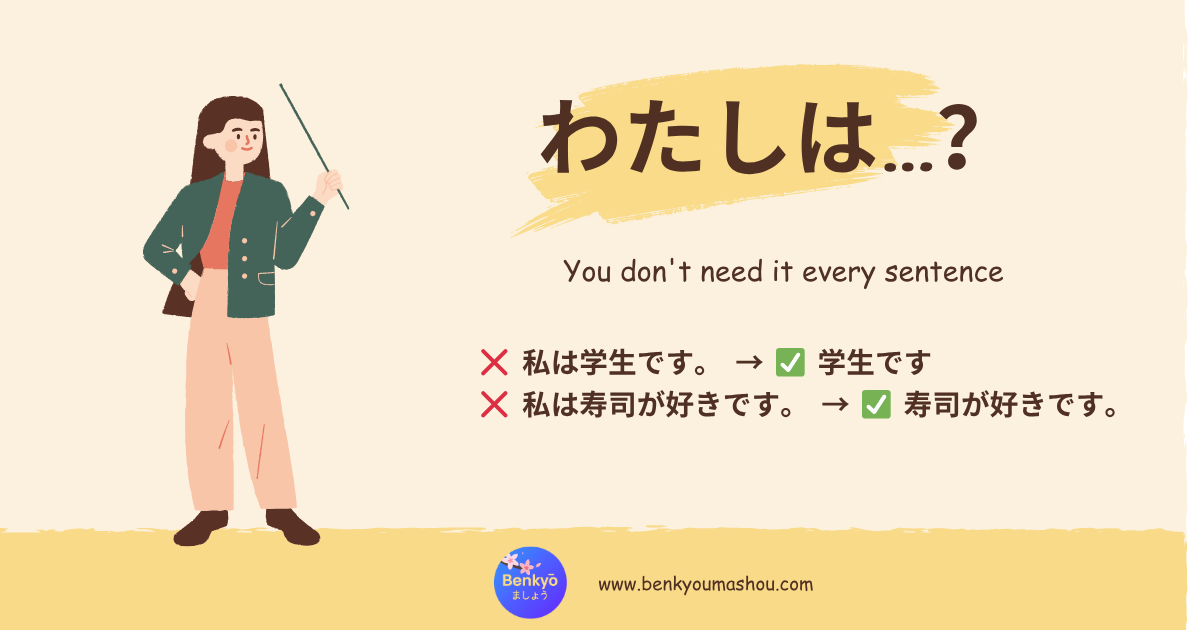
The short version: Japanese only names the subject when it adds new information. 私は is not the word "I." It means something closer to "as for me," and once everyone already knows you are talking about yourself, repeating it sounds like you keep insisting on the point.
In Japanese, leaving the subject out is the normal, natural choice. You name yourself only when it genuinely adds something.
Table of Contents
Why "watashi wa" everywhere sounds unnatural
Here is the thing English never warns you about: は is not a subject pronoun. It is the topic particle. 私は means "speaking of me," and it sets you as the topic of the conversation. The key word is sets. You do it once, and that topic stays running in the background until something changes it. You do not re-announce it every sentence.
English forces a subject into every clause, so "I am a student. I study Japanese. I like sushi" sounds fine. Translate that word for word and you get the Japanese equivalent of "As for me, I am a student. As for me, I study Japanese. As for me, I like sushi." Grammatical, but exhausting.
Listen to how a learner and a native speaker answer the same three questions:
| Question |
Learner (overusing) |
Natural |
| お仕事は? |
私は学生です |
学生です |
| 週末何をしますか? |
私は映画を見ます |
映画を見ます |
| 寿司は好きですか? |
はい、私は好きです |
はい、好きです |
The listener already knows you mean yourself, because you are the one answering. 私は adds no information, so it just adds weight. Worse, because は can carry contrast ("as for me, unlike others"), piling it on can quietly make you sound defensive, as if someone keeps challenging who you are talking about.
The simple rule
Most of the advice comes down to one test:
If the sentence still points clearly at you without 私は, leave it out.
Run the test on your own sentences. 「疲れた」 (tired) with no subject is obviously about you. So is 「わかりました」 (got it) and 「行きます」 (I'll go). The meaning does not wobble when you remove 私は, which means it was never carrying its weight.
The rest of this guide is really just that rule, applied to the situations where the subject is not obvious, so you know exactly when to put 私は back.
Fixing the self introduction
Look again at the self introduction from the opening:
Too much 私は:
私は田中さんの同僚です。
私はアメリカから来ました。
私は日本語を勉強しています。
More natural:
はじめまして。田中さんの同僚です。
アメリカから来ました。
日本語を勉強しています。
Nothing important disappeared. The listener still knows who is speaking. The natural version simply stops re-labeling the speaker in every sentence.
When you can drop it
This covers the large majority of your sentences:
- Answering a question about yourself. The question already aimed at you.
- Continuing to talk about yourself. Say it once, and the topic stays "you" for the next several sentences.
- Stating your own actions, feelings, or plans: 疲れた (I'm tired), お腹すいた (I'm hungry), わかりました (I understand), 行ってきます (I'm off).
If you are not sure, default to dropping it. Native speakers lean toward leaving things out, not putting them in.
When you actually want watashi wa
私は is not wrong. The goal is not to delete 私は forever. The goal is to stop using it automatically.
It is a precise tool, and these are the moments it earns its place:
| Use it when |
Example |
Why |
| Introducing yourself the first time |
はじめまして。私は田中です |
You are naming a brand new topic: you |
| Contrasting yourself with someone |
彼は行きます。私は行きません |
は marks the contrast: he is, I am not |
| Switching the topic back to you |
After talking about a friend: では私は… |
You are re-activating yourself as topic |
| Stating a personal opinion |
私はそう思います |
Signals "personally, I think..." |
| Correcting who did something |
いいえ、私はやっていません |
You are pushing back on a wrong assumption |
The thread running through all of these: you reach for 私は when "me" is new, contrasted, or being corrected, not when it is already understood. One self introduction needs it once at the top, then drops it for the rest.
Watashi wa vs watashi ga
This is the upgrade most learners skip, and it changes the meaning completely. は is your topic ("as for me"); が identifies you as the answer ("it is me, not anyone else").
- 私はやります = As for me, I'll do it. (Others might too.)
- 私がやります = I'll do it. (I am the one. Not them.)
So if someone asks 「誰がやりますか」 (Who will do it?), the natural answer is 私がやります, never は. The question is hunting for which person, and が is how Japanese hands over that piece of new information. Getting this right is the single biggest jump after you stop overusing 私は. We break the whole topic-versus-identifier idea down in our は vs が guide, and you can drill it on the が particle page.
It is not just "I": Japanese drops "you" too
Once you see the pattern, you notice Japanese omits everything the listener can already fill in, not just 私.
You (あなた). Beginners overuse あなた the same way, and it is a bigger problem, because said to someone's face it can feel like pointing a finger. Use the person's name plus さん, or nothing:
- あなたは何をしますか → stiff, slightly cold
- 田中さんは何をしますか → natural and warm
- 何をしますか → perfectly fine when it is obvious
It, them, the thing we both know about. A whole exchange can run with almost no pronouns at all:
A: 食べた? (Did you eat it?)
B: うん、食べた。 (Yeah, I ate it.)
No "you," no "I," no "it." Both speakers trust context to carry them. English keeps subjects because its grammar demands them; Japanese drops them because its grammar does not. When in doubt, leave them out.
Other ways to say I
When you do need to name yourself, 私 is only one option. The word you pick quietly signals formality, gender, and how close you are to the listener:
| Word |
Who uses it |
Feel |
| 私 |
Anyone |
Neutral, polite-safe default |
| 私 |
Anyone, formal |
Very polite, business and ceremony |
| 僕 |
Mostly men and boys |
Soft, casual but still polite |
| 俺 |
Mostly men |
Rough, casual, with close friends |
| あたし |
Mostly women |
Casual, friendly |
| 自分 |
Anyone |
"Myself," humble or sporty |
Two notes. First, the same rule still applies: pick the right word, use it once to establish who you are, then let it drop. Second, when you are not sure, 私 is never wrong. It is the safe default in almost any situation. The full set of words for I, you, he, she and we, with who says each one, is in our guide to Japanese pronouns.
See it for yourself: paste a few natural Japanese sentences into our Sentence Analyzer and notice how often the "I" and "you" simply are not there.
Quick check
If 私は is only repeating what the listener already knows, remove it:
| Heavy |
More natural |
| 私は毎日コーヒーを飲みます。 |
毎日コーヒーを飲みます。 |
| 私は日本語を勉強しています。 |
日本語を勉強しています。 |
| 私は明日行きます。 |
明日行きます。 |
Common mistakes
- Starting every sentence with 私は. Set the topic once, then let it ride.
- Using 私は to answer "who?" That is が's job: 私がやります.
- Translating English word for word. English needs a subject in every clause. Japanese does not.
- Reaching for あなた. Use a name plus さん, or nothing.
- Forcing it back in out of fear of being unclear. If the sentence is already obvious, adding 私は makes it heavier, not clearer.
Bottom line
私は is not the Japanese word you attach whenever English says "I." It is a topic marker. Use it when you are introducing yourself, contrasting yourself with someone else, correcting an assumption, or bringing the topic back to yourself.
In ordinary conversation, once the listener knows you are talking about yourself, drop it:
- 毎日コーヒーを飲みます。
- 映画が好きです。
- 明日東京に行きます。
All three sound complete because the context already supplies "I." That is the habit to build: say the useful information, and let Japanese leave the obvious parts unsaid.
Reading about this is one thing. The habit clicks faster when you actually speak and hear the rhythm of dropped subjects. Benkyou Mashou gives you conversation drills, instant feedback on what you say, flashcards, and step-by-step lessons from day one.
FAQ
Is it wrong to say watashi wa?
No. It is correct grammar and sometimes exactly right. It only sounds unnatural when you repeat it in sentences where the subject is already obvious.
Do Japanese people actually say watashi wa?
Yes, but sparingly: in self introductions, contrasts, and when stating a personal opinion. In casual conversation they drop it most of the time.
Will dropping watashi wa ever cause confusion?
Rarely. Context usually makes the subject clear. If a sentence is genuinely ambiguous about who you mean, that is the exact moment to add 私は (or 私が) back. That is the tool doing its real job.
Is watashi wa more polite?
Not really. Politeness in Japanese comes from verb forms (です/ます, keigo), not from spelling out the subject. Dropping 私は is still perfectly polite.
Keep leveling up your particles: