The Quick Reference Table
Here is the whole map in one place. "Formality" is a rough guide: the same word can feel warm between friends and rude to a stranger.
| Pronoun |
Reading |
Meaning |
Who uses it |
Formality |
| わたくし |
watakushi |
I |
anyone, at work, ceremonies, to customers |
very formal |
| 私 |
watashi |
I |
anyone in polite speech; women also casually |
polite, neutral |
| あたし |
atashi |
I |
women and girls, casual |
casual |
| 僕 |
boku |
I |
men and boys, polite to casual |
soft, friendly |
| 俺 |
ore |
I |
men, with friends and family |
casual |
| うち |
uchi |
I |
girls and young women, Kansai and beyond |
casual |
| 自分 |
jibun |
I (or "you" in Kansai) |
earnest men, sports teams, the military |
stiff |
| わし |
washi |
I |
older men, some western dialects |
casual, old |
| あなた |
anata |
you |
written questions, forms, strangers; wives, in older usage |
polite but distant |
| 君 |
kimi |
you |
to juniors, partners, in songs |
casual, from above |
| あんた |
anta |
you |
casual, can be warm or rude |
casual |
| お前 |
omae |
you |
close male friends, or a scolding |
rough |
| 彼 |
kare |
he; boyfriend |
anyone |
neutral |
| 彼女 |
kanojo |
she; girlfriend |
anyone |
neutral |
| あの人 |
ano hito |
that person, he, she |
anyone |
neutral |
| あの方 |
ano kata |
that person (polite) |
about someone above you |
polite |
| 私たち |
watashitachi |
we |
anyone |
polite, neutral |
| 我々 |
wareware |
we |
speeches, formal writing |
formal |
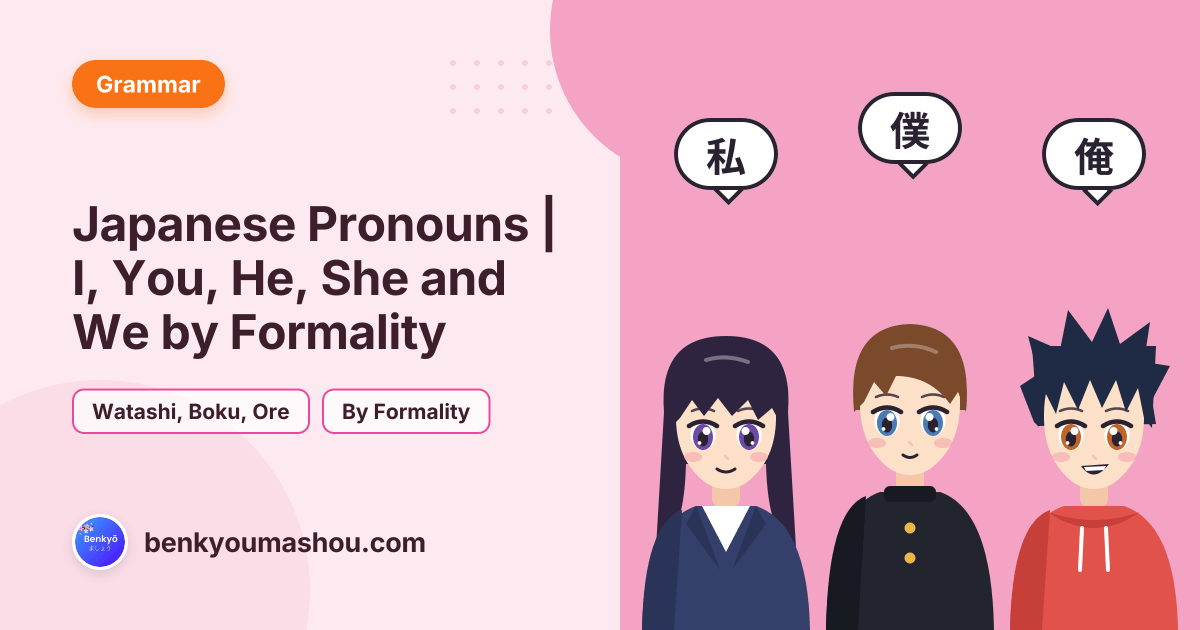
If you only learn four rows, learn 私, 僕, 俺 and the fact that あなた is rarer than you think. Everything else builds on those.
Words for "I"
私 (watashi): the safe default
私 is the "I" you learn first, and it is the right first choice. In polite speech it works for everyone, any age, any gender. At a job interview, with a doctor, with a new neighbour, 私 is almost always a safe choice.
私は大阪出身です。
Watashi wa Oosaka shusshin desu.
I'm from Osaka.
The one thing to know: when men use 私 with close friends, it can sound oddly formal, like wearing a suit to a barbecue. Women use 私 casually all the time, and it sounds natural.
わたくし is written with the same kanji 私, so you only know which one is meant from context or from hearing it. It belongs to formal settings: speaking to customers, giving a speech, apologizing on the phone at work.
わたくし、営業部の田中と申します。
Watakushi, eigyoubu no Tanaka to moushimasu.
I am Tanaka from the sales department.
In daily life you will hear it from shop staff, announcers and people in suits more than from friends.
僕 (boku): soft and friendly
僕 is used by boys and men. It sounds polite enough for many situations but gentler than 私, a bit boyish and approachable. A lot of men use 僕 at work with colleagues and 俺 with friends.
僕もそう思います。
Boku mo sou omoimasu.
I think so too.
Some women and girls use 僕 as well, especially in songs, manga and among friends, but in everyday speech it reads as male.
俺 (ore): casual and masculine
俺 is the everyday casual "I" for a great many men. With friends, brothers, teammates and family it sounds relaxed and completely normal; the son on the phone in our opening story is a typical user. It only starts to feel rough when it turns up in a polite setting.
俺、腹減った。
Ore, hara hetta.
I'm starving.
With a teacher or a client, 俺 usually sounds too casual, so it is a common slip for learners who picked it up from friends or anime.
✗ 部長、俺がやります。 (to your department head)
✓ 部長、私がやります。 "I'll do it, sir."
あたし (atashi) and うち (uchi)
あたし is a casual, softer form of 私 used mostly by women and girls. It is common in speech, in manga and in song lyrics, and it rarely appears in formal writing.
うち literally means "inside" or "home," and as "I" it is popular with girls and young women, strongly in Kansai and now well beyond it. うち also means "my family" or "our company," as in うちの母 (my mother) or うちの会社 (our company), and that second use is something everyone says.
自分 (jibun) and わし (washi)
自分 means "oneself." Some men use it as "I," and it sounds earnest and a little stiff: you hear it from athletes in interviews, from members of strict school clubs and from people with a military background. Be careful in Kansai, where 自分 is also a casual word for "you." 自分、何食べる? from an Osaka friend means "What are you having?"
わし is the "I" of older men in manga and dramas, and in some western dialects (Hiroshima, for example) men of any age use it. For a learner, it is one to recognize, not to adopt.
The literary ones
Japanese literature is full of "I" words that nobody uses in daily life now. The most famous is 吾輩, from the first line of Natsume Soseki's 1905 novel 吾輩は猫である, "I Am a Cat." The narrator is a cat using a pompous, old-fashioned "I," which is the joke. You will also meet 拙者 from samurai characters. Fun to know, odd to say.
How to Pick Your Own "I"
This is the question every learner eventually asks, so here is a practical answer rather than a list.
If you are a woman: use 私 everywhere. It is polite at work and natural with friends. Try あたし later if you hear your friends use it and it feels right.
If you are a man: use 私 in polite situations, and 僕 with classmates, colleagues you are friendly with, and anyone you are not sure about. 俺 can wait until you have Japanese friends who use it with you. A foreigner using 俺 too early can sound like someone copying anime.
If you prefer not to sound gendered: 私 works for everyone and nobody will think twice.
Japanese speakers switch between these all day. One man might say わたくし on the phone to a client, 私 in a meeting, 僕 at lunch with a coworker and 俺 at home. That switching is normal and expected. Picking one "I" for every situation is the unusual choice.
Words for "You", and Why People Avoid Them
Here is the part that surprises most learners: Japanese people rarely say "you" to someone's face, and the textbook word あなた is often the wrong one.
What people say instead
The normal way to address someone is with their name plus さん, or their role.
田中さんは明日来ますか。
Tanaka-san wa ashita kimasu ka.
Are you coming tomorrow? (to Tanaka)
You ask Tanaka about Tanaka, by name, while talking to Tanaka. It feels strange in English and completely natural in Japanese. With a teacher, you say 先生. With your manager, their title, like 部長. Shop staff call you お客様. And very often, as with "I," nobody says anything at all: 明日来ますか is a perfectly complete question.
あなた (anata): correct, but used with care
あなた is correct Japanese, and you will see it constantly in writing aimed at a general reader: quizzes, ads, song lyrics, signs. あなたの夢は何ですか on a poster means "What is your dream?" for anyone reading.
It also works in some polite spoken situations, for example when you genuinely do not know someone's name. Said to a person whose name you know, though, it can feel distant, because you are choosing a pronoun over their name, and to someone above you it can come across as rude.
✗ 先生に:あなたはどう思いますか。
✓ 先生はどう思いますか。 "What do you think, Sensei?"
There is one warm use: in older couples, a wife may call her husband あなた, a little like "dear." It is less common among younger couples, but you will hear it in dramas.
君, あんた, お前
君 (kimi) is used to someone equal or below: a boss to a junior, a man to his girlfriend, a teacher to a student, and all over song lyrics. It sounds friendly from above and presumptuous from below.
あんた (anta) is a casual squash of あなた. Between close friends or family, especially in some regions, it can be warm. From a stranger, or in an argument, it sounds rough.
お前 (omae) is the male, casual, rough "you." Close friends use it with each other, and it is also the "you" of a scolding parent or an angry boss. Funny detail: お前 literally means "honourable front" and was once respectful. So was 貴様, written "noble" plus a respectful suffix, which is now a strong insult you mostly hear in anime fights. Words for "you" in Japanese tend to slide downhill over the centuries, which is part of why people avoid them.
He, She and They
彼 (kare) and 彼女 (kanojo)
彼 means "he" and 彼女 means "she," but both are used less than in English, and both carry a second meaning that catches learners out.
彼女がいますか。
Kanojo ga imasu ka.
Do you have a girlfriend?
Without context, 彼女 often means "girlfriend," and 彼 or 彼氏 means "boyfriend." So if you point at a coworker and say 彼女は親切です, people will understand "she is kind," but a sentence like 彼女と映画に行きました will usually be heard as "I went to a movie with my girlfriend."
What people use instead
山田さんは来ません is more natural than 彼は来ません when you both know Yamada.
When there is no name, Japanese uses "that person":
| Word |
Meaning |
Feel |
| この人 / その人 / あの人 |
this / that person |
neutral |
| この方 / あの方 |
this / that person |
polite, for someone you respect |
| こいつ / あいつ |
this / that guy |
casual, can be rude |
| 彼ら / 彼女たち |
they (men or mixed / women) |
neutral |
あの方はどなたですか, "Who is that person?", is how you ask about a guest at a formal event. あいつ is for a friend you are teasing, or someone you are annoyed with, and it never goes near a customer.
We, Us and Plural Endings
Japanese makes plurals of people with a small set of endings, and "we" is built the same way.
| Ending |
Example |
Feel |
| 〜たち |
私たち, 僕たち, 子供たち |
neutral, the default |
| 〜ら |
俺ら, 彼ら |
casual, a bit rough with 俺 |
| 〜方 |
あなた方, 先生方 |
polite, for others |
| 〜ども |
私ども |
humble, for your own side at work |
私たちは同じクラスです。
Watashitachi wa onaji kurasu desu.
We are in the same class.
我々 (wareware) is the formal "we" of speeches, reports and company statements. Use it in a presentation, not at dinner. And casual groups of girls and young women often say うちら, the plural of うち.
One more trap: たち does not always mean an exact plural. 田中さんたち means "Tanaka and the people with him," not several Tanakas.
Pronouns at Work and in Keigo
Business Japanese replaces most pronouns with set words that show which side you are on. The pattern is humble for your side, respectful for theirs.
| Plain idea |
Your side (humble) |
Their side (respectful) |
| I |
わたくし |
|
| we, our company |
弊社, 私ども |
|
| you, your company |
|
御社 (spoken), 貴社 (written) |
| this side / that side |
こちら |
そちら, そちら様 |
| who |
|
どちら様, どなた |
On the phone, こちら and そちら do the work of "we" and "you": こちらから折り返しお電話いたします means "We will call you back." In a job interview, you always say 御社 for the company you are applying to, and a cover letter uses 貴社.
These words sit inside the larger system of polite speech. If you want the verbs that go with them, our keigo lesson on honorific and humble speech walks through it, and the grammar pages on sonkeigo and kenjougo cover the respectful and humble forms one at a time.
This, That and Who
Japanese also has pointing words that act as pronouns for things and places: これ, それ, あれ for "this," "that" and "that over there," plus こちら, そちら, あちら as their polite cousins. They follow the same こ・そ・あ・ど pattern, close to me, close to you, far from both, and which one, and they are covered in detail on our page about kore, sore and are.
For people, the question word is 誰 (dare), "who," and the polite version is どなた. On the phone or at the door, the politest form is どちら様ですか, "May I ask who is calling?" The full set of question words is in our guide to Japanese question words.
Try It Yourself
Pick the most natural word for each situation. The answers are below.
- You are introducing yourself at a job interview. ( ) は山本と申します。
a) 俺 b) わたくし c) うち
- You want to ask your teacher for her opinion. ( ) はどう思いますか。
a) あなた b) 君 c) 先生
- Two male university friends are making weekend plans. ( ) も行くよ。
a) 俺 b) わたくし c) 我々
Answers: 1 is b, わたくし, because an interview is as formal as daily life gets. 2 is c, 先生, because you address a teacher by her role, never with あなた or 君. 3 is a, 俺, the natural casual "I" between male friends; 僕 would also be fine.
If a sentence in a drama or a manga confuses you because you cannot tell who is being talked about, paste it into the Japanese sentence analyzer. It breaks the sentence into parts and shows where the subject has been dropped, which is usually the missing pronoun.
How to Get Comfortable With Them
Listen for who says what. Next time you watch a Japanese drama, notice which "I" each character uses. The serious boss says 私, the young colleague says 僕, the rebel says 俺, and the scriptwriters chose those on purpose. Pronouns are characterization in Japanese, and once you hear it you cannot unhear it.
Copy the people you talk to. If your Japanese friends say 俺 with you, it is fine to say it back. If your coworkers drop pronouns and use names, do the same. Matching your listener is safer than any rule in a table.
Speak, because reading is not enough. You can know all of this and still say あなた to your teacher in the moment, because the English habit is strong. The fix is saying real sentences to real people until the right word comes out on its own. If you do not have a conversation partner yet, the speaking practice on Benkyou Mashou is one place to start.
Pronouns are a small part of Japanese grammar and a big part of how you come across. None of the rules here are absolute: real speakers bend them all the time, and the word that fits depends on the room. But if you start with 私 or 僕, use names where English would say "you," and listen to how the people around you talk, you will sound more natural than most textbook learners.