I was standing in a packed Tokyo train station, trying to squeeze through a wall of commuters during rush hour. I said "ごめんなさい" over and over as I pushed past people. A Japanese friend later told me I sounded like I was apologizing for something terrible. The right word was "すみません." A phrase that sounds polite in one situation can sound strangely serious in another.
Japanese does not use one phrase for every kind of "excuse me." There are separate words for bumping into someone, getting a waiter's attention, entering someone's home, and interrupting a meeting. Picking the wrong one can sound unnatural or way too strong for the situation.
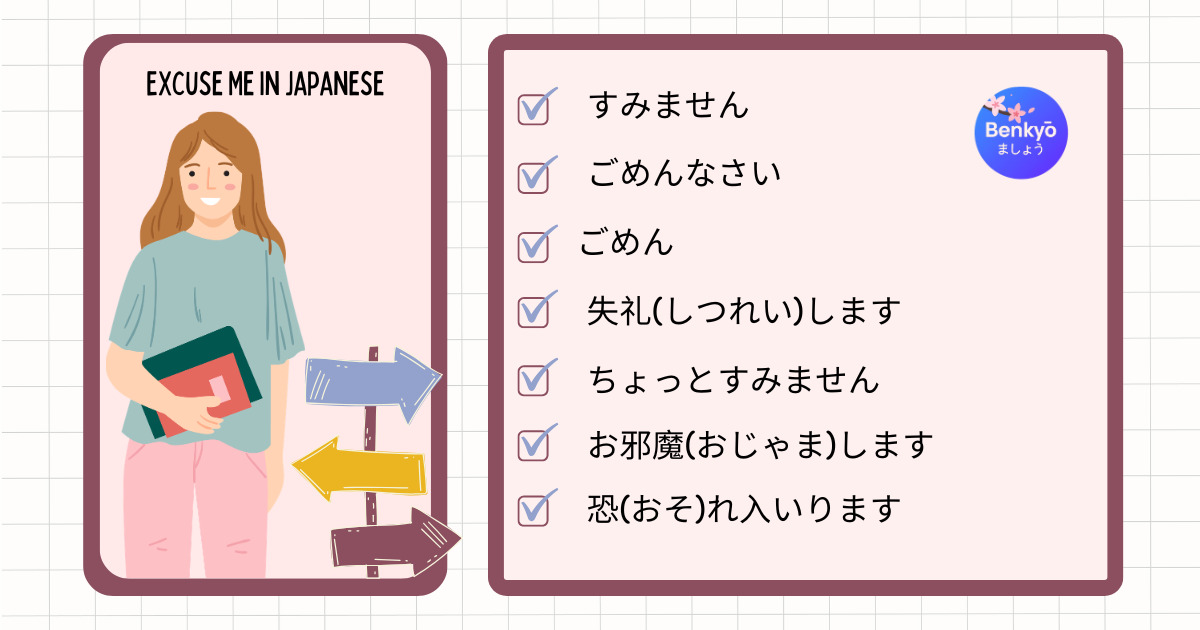
Here are 7 common phrases that cover most everyday situations, when to use each one, and the mistakes that can sound unnatural or too strong.
Short answer: the safest, most natural way to say excuse me in Japanese is すみません (sumimasen). It covers getting past someone, calling a waiter, and light apologies. The other six phrases below handle more specific situations, from casual to very formal.
Table of Contents
- Quick Comparison Chart
- 1. すみません (Sumimasen) — The Safest Everyday Choice
- 2. ごめんなさい (Gomen nasai) — The Real Apology
- 3. ごめん (Gomen) — The Casual Sorry
- 4. 失礼します (Shitsurei shimasu) — The Professional One
- 5. ちょっとすみません (Chotto sumimasen) — Getting Someone's Attention
- 6. お邪魔します (Ojama shimasu) — Entering Someone's Space
- 7. 恐れ入ります (Osore irimasu) — The Ultra-Formal Business Phrase
- Common Mistakes
- Which One Should You Use? (Flowchart)
- Choosing by Situation
Quick Comparison Chart
Before we dig into each phrase, here's the overview:
| Phrase | Meaning | Formality | When to Use |
|---|---|---|---|
| すみません | Excuse me / Sorry | Polite | Strangers, light apologies, getting attention |
| ごめんなさい | I'm sorry | Polite | Real apologies, admitting fault |
| ごめん | Sorry / My bad | Casual | Friends, family |
| 失礼します | Excuse me (formal) | Formal | Entering/leaving rooms, professional settings |
| ちょっとすみません | Excuse me (attention) | Polite | Calling a waiter, asking strangers for help |
| お邪魔します | Pardon the intrusion | Polite | Entering someone's home or office |
| 恐れ入ります | I'm terribly sorry / Excuse me | Very formal | Business, customer service, keigo |
Now let's look at each one in detail.
1. すみません (Sumimasen) — The Safest Everyday Choice
すみません is the most versatile "excuse me" in Japanese. If you're not sure which phrase to use, this one will get you through most daily situations: getting past someone, calling a waiter, apologizing for being late.
What It Actually Means
The word comes from the verb 済む (to be finished/settled). すみません literally means "it is not settled," the feeling that you've caused an inconvenience that hasn't been resolved.
When to Use It
Getting past someone:
すみません、通してください。
Sumimasen, tooshite kudasai.
Excuse me, please let me through.
Calling a waiter or staff member:
すみません、注文をお願いします。
Sumimasen, chuumon wo onegai shimasu.
Excuse me, I'd like to order please.
Light apology (bumping someone, being slightly late):
すみません、遅れました。
Sumimasen, okuremashita.
Sorry I'm late.
Thanking someone (yes, really):
Japanese people often say すみません when receiving a gift or favor, where English speakers would say "thank you." The nuance is "I'm sorry for the trouble you went through for me."
A: ここに置いておきますね。 (I'll leave it here for you.)
B: あ、すみません! (Oh, thank you! / literally "I'm sorry [for the trouble]")
Casual Version: すいません (Suimasen)
In everyday speech, すみません often gets shortened to すいません. Same meaning, just faster to say. You'll hear this constantly on trains and in restaurants. Both are fine to use.
How Formal Is It?
Sumimasen is polite enough for strangers, shops, restaurants, and most daily interactions. It's not formal enough for business meetings or talking to your boss's boss. For those, keep reading. If you're still building your basics, our First Greetings lesson covers すみません alongside other essential phrases.
2. ごめんなさい (Gomen nasai) — The Real Apology
すみません is "excuse me" with a light apology built in. ごめんなさい is different. It's a genuine "I'm sorry." You're admitting that you did something wrong.
The Key Difference
すみません = "Sorry for the inconvenience" (you may not have done anything wrong)
ごめんなさい = "I'm sorry, it's my fault" (you're taking responsibility)
When to Use It
You made a real mistake:
ごめんなさい、約束を忘れました。
Gomen nasai, yakusoku wo wasuremashita.
I'm sorry, I forgot our plans.
You hurt someone's feelings:
ごめんなさい、そんなつもりじゃなかった。
Gomen nasai, sonna tsumori ja nakatta.
I'm sorry, I didn't mean it that way.
You broke or lost something:
ごめんなさい、お皿を割ってしまいました。
Gomen nasai, osara wo watte shimaimashita.
I'm sorry, I broke the plate.
Notice the ~てしまう (te shimau) pattern there. It adds the feeling of "unfortunately" or "I accidentally did something I regret." Pairs naturally with ごめんなさい.
When NOT to Use It
Don't use ごめんなさい when you're just trying to get past someone on the train or get a waiter's attention. It can sound much more serious than the situation requires. Use すみません instead.
Also avoid ごめんなさい with superiors at work. It's polite but not formal enough for business contexts. In professional settings, use 申し訳ございません (moushiwake gozaimasen) for serious business apologies.
3. ごめん (Gomen) — The Casual Sorry
ごめん is ごめんなさい with the なさい chopped off. Same meaning, much more casual. Closer to "my bad" in English.
When to Use It
With close friends:
ごめん、今日行けない。
Gomen, kyou ikenai.
Sorry, I can't go today.
This uses the potential form. 行けない is the negative potential of 行く.
With family:
ごめんごめん、待った?
Gomen gomen, matta?
Sorry sorry, did you wait?
Doubling it (ごめんごめん) makes it even more casual and is very common.
In text messages:
ごめん is the go-to texting apology in Japanese. ごめんなさい feels stiff in LINE or text messages between friends.
Variations
| Phrase | Nuance | Gender |
|---|---|---|
| ごめん | Casual sorry | Anyone |
| ごめんね | Softer, slightly sweet | Often female, but anyone |
| ごめんごめん | Very casual "sorry sorry" | Anyone |
| ごめんなー | Drawn out, casual | Often male |
When NOT to Use It
Never use ごめん with strangers, teachers, bosses, or anyone older than you who you're not close with. It comes across as disrespectful. Imagine responding to your professor with "my bad."
4. 失礼します (Shitsurei shimasu) — The Professional One
失礼します literally means "I will commit a rudeness." You'll hear it constantly in Japanese offices, meetings, and any situation that calls for formal manners.
When to Use It
Entering a room (office, meeting room, teacher's office):
失礼します。田中と申します。
Shitsurei shimasu. Tanaka to moushimasu.
Excuse me. My name is Tanaka.
Leaving a room or ending a conversation:
お先に失礼します。
Osaki ni shitsurei shimasu.
Excuse me for leaving before you.
This is what you say when leaving the office before your coworkers. It's such a standard phrase that most Japanese workers say it on autopilot every evening.
Hanging up the phone:
では、失礼します。
Dewa, shitsurei shimasu.
Well then, excuse me. (goodbye)
Reaching across someone or doing something slightly impolite:
失礼します。(reaching past someone to grab a document)
Shitsurei shimasu.
Excuse me. (for reaching across you)
Past Tense: 失礼しました (Shitsurei shimashita)
Use the past tense when you've already done the rude thing:
失礼しました、名前を間違えました。
Shitsurei shimashita, namae wo machigaemashita.
I'm sorry, I got your name wrong.
失礼します is "I'm about to be rude" (before). 失礼しました is "I was rude" (after). Same ます → ました pattern you see across all Japanese verbs.
5. ちょっとすみません (Chotto sumimasen) — Getting Someone's Attention
Adding ちょっと (a little) before すみません softens the interruption. It's the natural way to flag down a stranger, a waiter, or a coworker who's busy.
When to Use It
Getting directions from a stranger:
ちょっとすみません、駅はどこですか?
Chotto sumimasen, eki wa doko desu ka?
Excuse me, where is the station?
Interrupting someone politely:
ちょっとすみません、一つ聞いてもいいですか?
Chotto sumimasen, hitotsu kiite mo ii desu ka?
Excuse me, may I ask one thing?
That ~てもいい pattern is the temo ii grammar for asking permission. Our Polite Requests lesson covers this in detail.
At a restaurant:
ちょっとすみません、お水をください。
Chotto sumimasen, omizu wo kudasai.
Excuse me, water please.
Why Not Just すみません?
Both work. But ちょっとすみません feels less abrupt. It's the difference between "Excuse me!" and "Hey, sorry, excuse me..." The ちょっと signals that you know you're interrupting and you'll be quick about it.
In busy restaurants, though, a clear すみません without the ちょっと carries better. The staff need to hear you over the noise.
6. お邪魔します (Ojama shimasu) — Entering Someone's Space
お邪魔します literally means "I will be a bother" or "I will intrude." It's what you say when entering someone's home, personal office, or private space.
When to Use It
Visiting a friend's apartment:
A: どうぞ、入って。 (Come in.)
B: お邪魔します! (Pardon the intrusion!)
Entering a professor's or boss's office:
お邪魔します。少しお時間よろしいですか?
Ojama shimasu. Sukoshi ojikan yoroshii desu ka?
Excuse the intrusion. Do you have a moment?
Leaving someone's home:
お邪魔しました!
Ojama shimashita!
Thank you for having me! (literally: I have intruded)
Past tense (しました) when leaving, present tense (します) when arriving. Same tense logic as 失礼します / 失礼しました.
Cultural Note
In Japanese culture, entering someone's space is treated as an imposition even when you're invited. お邪魔します shows you're aware of that. Not saying it when entering a Japanese person's home is a noticeable miss.
7. 恐れ入ります (Osore irimasu) — The Ultra-Formal Business Phrase
恐れ入ります literally means "I am filled with fear/awe." It's keigo (honorific language) and the most formal way to say "excuse me" in Japanese. You'll hear it in business settings, customer service, and formal phone calls.
When to Use It
Making a request to a client or superior:
恐れ入りますが、お名前をお聞かせいただけますか?
Osore irimasu ga, onamae wo okikase itadakemasu ka?
I'm terribly sorry to bother you, but may I have your name?
Customer service:
恐れ入りますが、少々お待ちいただけますか?
Osore irimasu ga, shoushou omachi itadakemasu ka?
I'm terribly sorry, but could you wait a moment?
Expressing deep gratitude in business:
恐れ入ります。ご丁寧にありがとうございます。
Osore irimasu. Goteinei ni arigatou gozaimasu.
I'm most grateful. Thank you for your kindness.
Do You Need This as a Learner?
If you're at the N5-N4 level, you probably won't use this phrase yourself. But you will hear it constantly at hotels, department stores, banks, and on customer service calls. Knowing what it means helps you understand what's happening around you.
If you're working in a Japanese company or dealing with Japanese clients, this phrase becomes essential. Our Keigo lesson covers the full honorific system.
Common Mistakes
| Mistake | ❌ Wrong | ✓ Better | Why |
|---|---|---|---|
| ごめんなさい with strangers | Bumping into someone: ごめんなさい! | すみません! | ごめんなさい implies real fault. For minor contact, すみません is the right level. |
| すみません for serious apologies | Forgot a meeting: すみません、忘れました。 | 申し訳ありません、忘れてしまいました。 | すみません feels too light for real mistakes at work. |
| ごめん with your boss | ごめん、資料まだです。 | 申し訳ありません、資料はまだ完成しておりません。 | ごめん is for friends and family only. Like saying "my bad" to the CEO. |
| お邪魔します at a restaurant | Entering a restaurant: お邪魔します! | Just walk in (staff will say いらっしゃいませ) | お邪魔します is for private spaces only: homes and personal offices. |
| すみません instead of ありがとう | Cashier hands you change: すみません! | ありがとうございます! | すみません as "thank you" only works when someone went out of their way for you (carrying bags, holding a door, giving a gift). |
Which One Should You Use? (Flowchart)
Not sure which phrase fits your situation? Follow this:
Are you entering someone's private space (home, personal office)?
→ Yes → お邪魔します
Are you in a formal business setting?
→ Yes → Is it a request or interruption? → 恐れ入ります
→ Yes → Are you entering or leaving a room? → 失礼します
Did you actually do something wrong?
→ Yes → Is it serious? → 申し訳ありません
→ Yes → Is it minor? → ごめんなさい (or ごめん to friends)
Are you trying to get someone's attention?
→ Yes → ちょっとすみません (or just すみません)
Everything else?
→ すみません
When in doubt in daily life, すみません is usually the safest choice. It might not be perfect for every situation, but it won't offend anyone.
Choosing by Situation
The phrases above aren't a simple scale from light to heavy. They fit different situations. すみません is broader (excuse me, sorry, thank you), while ごめんなさい is a more direct personal apology. Here's a quick reference:
| Situation | Best Phrase |
|---|---|
| Friend / casual mistake | ごめん |
| Real personal apology | ごめんなさい |
| Stranger / light apology / getting attention | すみません |
| Formal manners (entering/leaving rooms) | 失礼しました |
| Serious work apology | 申し訳ありません |
| Very formal business apology | 申し訳ございません |
The daily life phrases (ごめん, ごめんなさい, すみません) are about your relationship to the person. The work phrases (失礼しました, 申し訳ありません) are about how formal the setting is.
Related Grammar Points
Grammar patterns used in the example sentences above:
- ~てもいい (temo ii) — asking for permission ("May I...?")
- ~てしまう (te shimau) — expressing regret ("I accidentally...")
- ~てください (te kudasai) — making requests
- ます form (masu) → ました form (mashita) — polite present/past
- Potential form — expressing ability ("can / can't")
Start Practicing
The easiest way to remember these phrases is to practice them in situations where they naturally appear: ordering food, visiting someone's home, asking for help, or speaking at work. Benkyou Mashou has conversation scenarios for these kinds of situations, with speaking practice and AI feedback.
For the grammar patterns used in the example sentences above, check our grammar reference. If you're just getting started, our Japanese lessons cover everything from kana to keigo.
頑張って!