Learning Japanese can be full of surprises. One moment you think you've got something figured out, and the next moment you realize there's so much more to discover.
Take the simple phrase "I want" for example. In English, it's straightforward—just two words. But in Japanese? There are actually two completely different ways to express wanting something, and mixing them up is one of the most common mistakes learners make.
Whether you want to order food at a restaurant, express your dreams and goals, or simply tell someone what you're craving, knowing when to use 〜たい (tai) versus 欲しい (hoshii) will make your Japanese sound natural and confident.
Let's dive into this essential grammar point that every Japanese learner needs to master.
Table of Contents
- The Golden Rule: Actions vs Objects
- Part 1: Using 〜たい for Actions
- Part 2: Using 欲しい for Objects
- Quick Comparison Guide
- Real-World Usage Examples
- Advanced Usage: Other People's Desires
- Common Mistakes and How to Avoid Them
- Practice Scenarios
The Golden Rule: Actions vs Objects
Here's the fundamental rule that will solve most of your confusion:
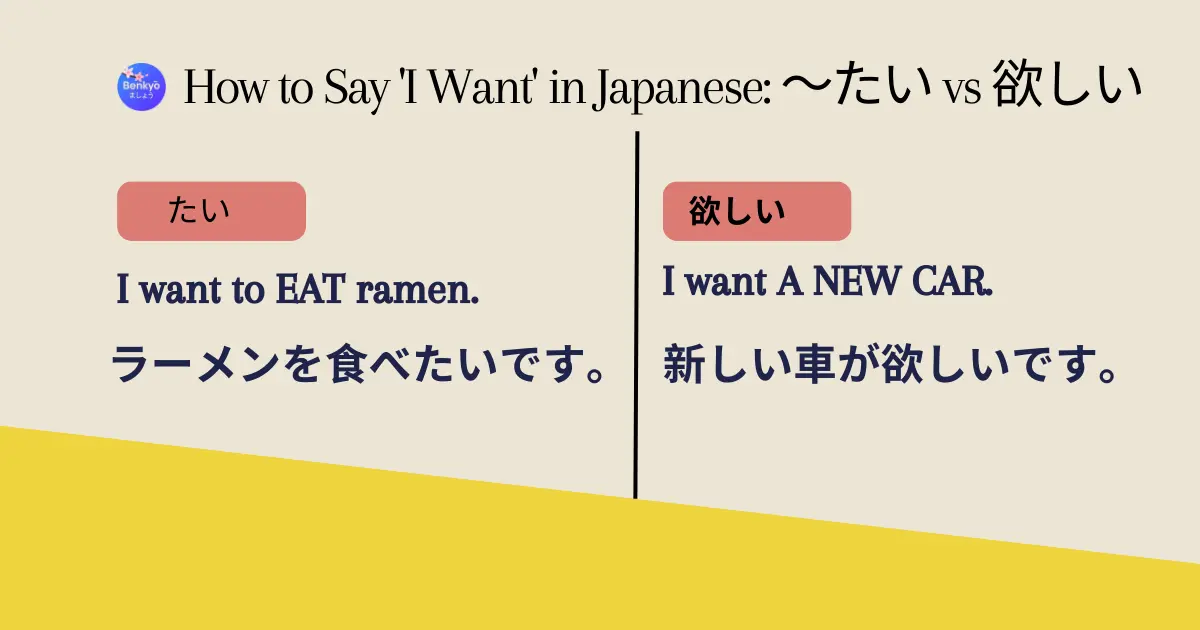
〜たい = "I want to DO something" (actions/verbs)
欲しい = "I want something" (objects/nouns)
Think of it this way: if you can replace "want" with "want to do," use 〜たい. If you just want to possess or have something, use 欲しい.
Quick Examples:
- 映画を見たいです (Eiga o mitai desu) → "I want to watch a movie"
- 映画のチケットが欲しいです (Eiga no chiketto ga hoshii desu) → "I want movie tickets"
See the difference? The first focuses on the action (watching), while the second focuses on possessing the item (tickets).
Part 1: Using 〜たい for Actions
How to Form 〜たい
The formation is beautifully simple:
- Take any verb in its 丁寧 (polite) ます form
- Remove the ます
- Add たい
Examples:
Dictionary Form → ます Form → たい Form → English
- 食べる → 食べます → 食べたい → "want to eat"
- 行く → 行きます → 行きたい → "want to go"
- 見る → 見ます → 見たい → "want to see"
- する → します → したい → "want to do"
Real Conversation Examples
At a 料理 Restaurant:
- 何を食べたいですか? (Nani o tabetai desu ka?) → "What do you want to eat?"
- 寿司を食べたいです (Sushi o tabetai desu) → "I want to eat sushi"
Making Plans:
- 今度の週末、映画を見たいです (Kondo no shūmatsu, eiga o mitai desu) → "I want to watch a movie this weekend"
- 友達と話したいです (Tomodachi to hanashitai desu) → "I want to talk with friends"
Expressing Dreams:
- 将来、日本で働きたいです (Shōrai, Nihon de hatarakitai desu) → "I want to work in Japan in the future"
Different Forms of 〜たい
Since たい acts like an i-adjective, it conjugates naturally:
Present: 食べたいです → "I want to eat"
Negative: 食べたくないです → "I don't want to eat"
Past: 食べたかったです → "I wanted to eat"
Past Negative: 食べたくなかったです → "I didn't want to eat"
Casual: 食べたい → "I wanna eat"
Need more detailed examples and practice with the たい form? Check out our complete guide to using 〜たい in Japanese for step-by-step formation rules and real conversation scenarios.
Particle Usage with 〜たい
Here's something interesting: with 〜たい, you can use either を or が for the direct object:
- ラーメンを食べたい → neutral tone
- ラーメンが食べたい → emphasizes the ramen
Both are correct, though を is more commonly used in everyday conversation.
Part 2: Using 欲しい for Objects
The 欲しい Structure
欲しい is an i-adjective that describes something as "desirable." The basic pattern is:
[Object you want] + が + 欲しい (です)
Important: Notice it's が (ga), not を (wo). This is because 欲しい is an adjective describing the object as desirable to you.
Common Examples
Everyday Items:
- 水が欲しいです (Mizu ga hoshii desu) → "I want water"
- 新しい車が欲しいです (Atarashii kuruma ga hoshii desu) → "I want a new car"
- コーヒーが欲しいです (Kōhii ga hoshii desu) → "I want coffee"
Abstract Concepts:
- もっと時間が欲しいです (Motto jikan ga hoshii desu) → "I want more time"
- 休みが欲しいです (Yasumi ga hoshii desu) → "I want a break/holiday"
Conjugating 欲しい
Like all i-adjectives, 欲しい changes form:
Present: 本が欲しいです → "I want a book"
Negative: 本が欲しくないです → "I don't want a book"
Past: 本が欲しかったです → "I wanted a book"
Past Negative: 本が欲しくなかったです → "I didn't want a book"
Pro tip: In negative sentences, the particle often changes from が to は for contrast:
- その本は欲しくないです (Sono hon wa hoshikunai desu) → "I don't want that book"
Quick Comparison Guide
〜たい (tai) - For Actions:
- Used for: Actions (verbs)
- Grammar: Verb stem + たい
- Example: 本を読みたい → "want to read a book"
- Particle: を or が
- Type: Acts like i-adjective
欲しい (hoshii) - For Objects:
- Used for: Objects/Things (nouns)
- Grammar: Noun + が + 欲しい
- Example: 本が欲しい → "want a book"
- Particle: が (never を)
- Type: Is an i-adjective
Real-World Usage Examples
Let's see how these work in practical situations:
At a 喫茶店 (Coffee Shop)
Scenario 1 - Wanting the drink itself:
- You: 水が欲しいです (Mizu ga hoshii desu) → "I want water"
Scenario 2 - Wanting to perform the action:
- You: 水を飲みたいです (Mizu o nomitai desu) → "I want to drink water"
Both are natural, but 飲みたい is slightly more common when ordering.
Talking About Your Career
For the job itself:
- 仕事が欲しいです (Shigoto ga hoshii desu) → "I want a job"
For the action of working:
- 働きたいです (Hatarakitai desu) → "I want to work"
Weekend Planning
Wanting time off:
- 休みが欲しいです (Yasumi ga hoshii desu) → "I want a day off"
Wanting to take action:
- 休みを取りたいです (Yasumi o toritai desu) → "I want to take a day off"
Advanced Usage: Other People's Desires
Here's something crucial that many textbooks don't emphasize enough: you generally cannot use 〜たい or 欲しい to directly state what other people want.
Why? In Japanese culture, you can't claim to know someone else's inner thoughts with certainty.
For Other People's Actions: 〜たがっている
Instead of 〜たい, use 〜たがっている (tagatte iru):
- 子供は外で遊びたがっています (Kodomo wa soto de asobitagatte imasu) → "The child wants to play outside"
For Other People's Objects: 欲しがっている
Similarly, 欲しい becomes 欲しがっている, and the particle changes from が to を:
- 友達は新しい靴を欲しがっています (Tomodachi wa atarashii kutsu o hoshigatte imasu) → "My friend wants new shoes"
Exceptions: When You Can Use 〜たい/欲しい for Others
-
In questions (asking directly):
- 何が食べたいですか? (Nani ga tabetai desu ka?) → "What do you want to eat?"
-
When quoting someone:
- 田中さんは「帰りたい」と言いました → "Tanaka-san said 'I want to go home'"
Common Mistakes and How to Avoid Them
Wrong particle with 欲しい
Wrong: 水を欲しいです (Mizu o hoshii desu)
Right: 水が欲しいです (Mizu ga hoshii desu)
Using 欲しい with verbs
Wrong: 映画を見ることが欲しいです
Right: 映画を見たいです (Eiga o mitai desu)
Remember: If there's a verb involved, use 〜たい
Direct statements about others' desires
Awkward: 友達は犬が欲しいです (Tomodachi wa inu ga hoshii desu)
Natural: 友達は犬を欲しがっています (Tomodachi wa inu o hoshigatte imasu)
Confusing similar-sounding words
Don't confuse:
- 欲しい (hoshii) = want (something)
- 美味しい (oishii) = delicious
- 楽しい (tanoshii) = fun
Practice Scenarios
Scenario 1: At a 本屋 (Bookstore)
What you might say:
- この本が欲しいです → "I want this book"
- 日本語の本を読みたいです → "I want to read Japanese books"
- 漫画を買いたいです → "I want to buy manga"
Scenario 2: Planning a 旅行 (Trip)
Expressing your desires:
- 沖縄に行きたいです → "I want to go to Okinawa"
- もっと時間が欲しいです → "I want more time"
- 温泉に入りたいです → "I want to go into hot springs"
Scenario 3: At 会社 (Work)
Professional settings:
- 新しいプロジェクトに参加したいです → "I want to participate in the new project"
- 昇進が欲しいです → "I want a promotion"
- スキルを向上させたいです → "I want to improve my skills"
文法 Quick Reference
For quick decision-making:
- Ask yourself: "Am I talking about DOING something or HAVING something?"
- If DOING: Use 〜たい
- Verb ます form → remove ます → add たい
- If HAVING: Use 欲しい
- [Thing] + が + 欲しい
For others' desires:
- Actions: 〜たがっている
- Objects: 欲しがっている (with を particle)
Conclusion
Mastering the difference between 〜たい and 欲しい is a significant step forward in your Japanese journey. This distinction reflects how Japanese thinks about desires and actions in a more nuanced way than English.
Remember the key points:
- 〜たい for actions you want to perform
- 欲しい for objects/things you want to have
- Different forms needed when talking about others
- Pay attention to particles (が with 欲しい, を/が with 〜たい)
The more you practice these patterns in real conversations, the more natural they'll become. Don't worry about making mistakes—every Japanese learner goes through this process!
頑張って!(Ganbatte! - Keep at it!)