Picture this. You are sitting in a small Tokyo cafe, and someone at the next table is drinking a matcha latte that looks incredible. You want to order the same thing, but the words freeze in your mouth. How do you actually say "I want to drink that" in Japanese?
That was me, years ago, pointing at menus like a tourist. The moment the たい (tai) form clicked, ordering, planning trips, and telling people what I actually wanted stopped being scary. It is one of the first grammar points that makes you sound like a person with real wishes instead of a walking textbook.
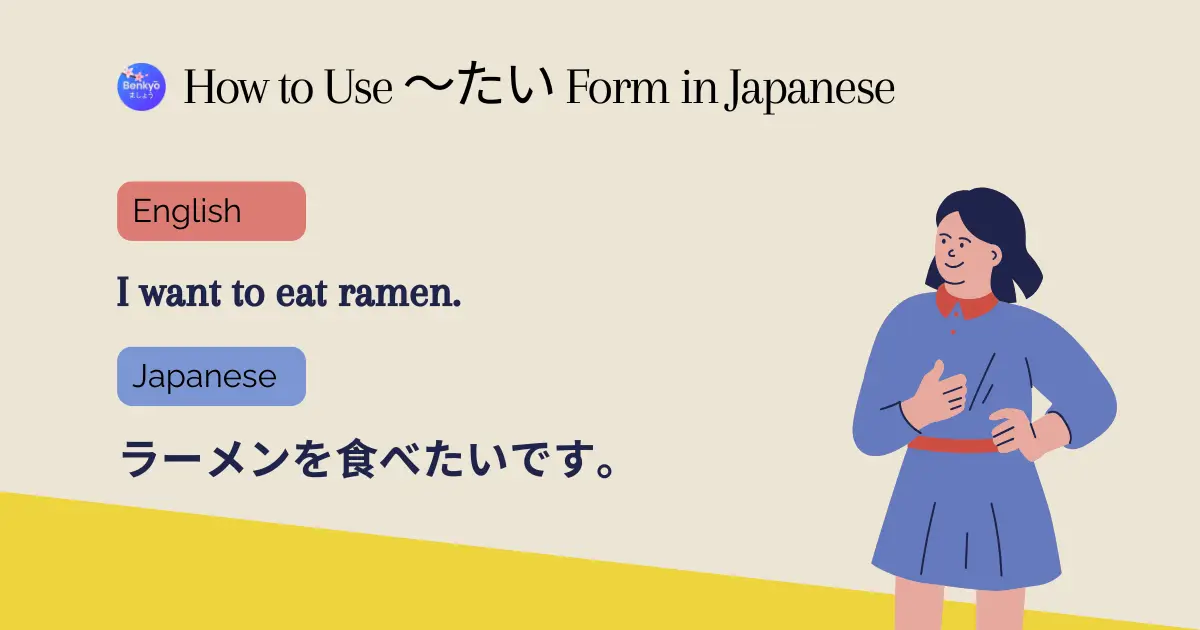
Short answer: the tai form means "want to do" an action. Take a verb's ます form, drop ます, and add たい. 食べます becomes 食べたい ("I want to eat"). After that, たい behaves like an i-adjective, so the negative is 食べたくない ("I don't want to eat").
Table of Contents
- What the tai form means
- How to make the tai form
- Tai form conjugation chart
- Tai form with を or が
- Asking what someone wants to do
- Talking about what other people want
- Tai form examples for daily conversation
- Softening it and going casual
What the tai form means
The tai form, written たい, attaches to a verb to say "want to do" that action. The key word is action. It is for things you do, not things you own.
| English | Japanese | Why |
|---|---|---|
| I want to eat sushi. | 寿司を食べたいです。 | 食べる is an action |
| I want water. | 水が欲しいです。 | water is an object |
Here is the feeling behind it. Compare these two:
日本に行きます。
Nihon ni ikimasu.
I will go to Japan. (a plain fact)
日本に行きたいです。
Nihon ni ikitai desu.
I want to go to Japan. (a personal wish)
The second one tells the listener something about you, not just your schedule. That emotional layer is exactly why たい is worth getting comfortable with. If the English sentence is "want a thing" rather than "want to do," you need 欲しい instead, which we cover in the たい vs 欲しい guide.
How to make the tai form
Two steps, and that is genuinely all there is to it.
ます form → drop ます → add たい
| Dictionary form | ます form | Tai form | Meaning |
|---|---|---|---|
| 食べる | 食べます | 食べたい | want to eat |
| 飲む | 飲みます | 飲みたい | want to drink |
| 見る | 見ます | 見たい | want to see |
| 買う | 買います | 買いたい | want to buy |
| する | します | したい | want to do |
| 来る | 来ます | 来たい | want to come |
The one thing beginners get wrong here is leaving ます attached. Drop it completely before adding たい.
✗ 食べますたいです
✓ 食べたいです
If forming the ます stem still feels shaky, the ます form guide and verb stem guide are worth a quick detour first, because everything here builds on that stem.
Tai form conjugation chart
This is the part that makes たい so powerful. Once a verb becomes たい, it stops acting like a verb and starts acting like an i-adjective. So you already know how to conjugate it.
| Form | Japanese | Meaning |
|---|---|---|
| Present | 食べたいです | I want to eat |
| Negative | 食べたくないです | I don't want to eat |
| Past | 食べたかったです | I wanted to eat |
| Past negative | 食べたくなかったです | I didn't want to eat |
| Casual | 食べたい | wanna eat |
| Casual negative | 食べたくない | don't wanna eat |
Notice the verb part never changes again. 食べ stays put, and only the たい ending shifts, exactly like 高い → 高くない → 高かった. A common slip is treating it like a noun and adding じゃない:
✗ 食べたいじゃないです
✓ 食べたくないです
Tai form with を or が
This trips up a lot of learners because older textbooks state it as a hard rule, and it is not one. With the tai form, both を and が are correct before the object. They just carry a slightly different feel.
| Sentence | Natural meaning |
|---|---|
| 寿司を食べたいです。 | I want to eat sushi. Neutral, action-focused. |
| 寿司が食べたいです。 | Sushi is the thing I want to eat. Focus on the sushi. |
So do not let anyone tell you 寿司が食べたい is wrong. It is natural and common. If you just want one safe default, use を, because it matches the normal object marker you already use for verbs, and reach for が when you want to spotlight the thing you are craving.
Where you do need to be careful is 欲しい, which is a different word for wanting objects. It takes が, not を:
✗ 水を欲しいです
✓ 水が欲しいです
Asking what someone wants to do
The tai form works beautifully in questions when you are asking someone directly.
何を食べたいですか。
Nani o tabetai desu ka.
What do you want to eat?
今度の週末、何をしたいですか。
Kondo no shuumatsu, nani o shitai desu ka.
What do you want to do this weekend?
You will use these constantly when you are making plans with friends, which is honestly where most real Japanese practice happens.
Talking about what other people want
Here is a subtle one that even confident learners miss. Japanese tends to avoid flatly declaring another person's inner feelings with たい, because you cannot actually see inside their head. When you report what someone else seems to want, switch to たがっている.
| Meaning | Better Japanese |
|---|---|
| He wants to go home. | 彼は帰りたがっています。 |
| The kids want to play. | 子供たちは遊びたがっています。 |
| My friend wants to study Japanese. | 友達は日本語を勉強したがっています。 |
Keep たい for yourself and for direct questions. Use たがっている when you are on the outside looking in.
✗ 彼は帰りたいです。 (sounds like you read his mind)
✓ 彼は帰りたがっています。
The one exception: if you are quoting the person's own words, たい is fine, because now it is their statement, not your guess.
彼は「帰りたい」と言いました。
Kare wa "kaeritai" to iimashita.
He said, "I want to go home."
Tai form examples for daily conversation
Here are lines you can lift straight into real situations.
At a restaurant
すみません、これを注文したいです。
Sumimasen, kore o chuumon shitai desu.
Excuse me, I want to order this.
Making plans
温泉に行きたいです。でも、買い物もしたいです。
Onsen ni ikitai desu. Demo, kaimono mo shitai desu.
I want to go to a hot spring. But I also want to go shopping.
Long-term goals
将来、日本で働きたいです。
Shourai, Nihon de hatarakitai desu.
I want to work in Japan in the future.
いつか富士山に登りたいです。
Itsuka Fujisan ni noboritai desu.
I want to climb Mt. Fuji someday.
When you are tired
家に帰りたいです。もう少し寝たいです。
Ie ni kaeritai desu. Mou sukoshi netai desu.
I want to go home. I want to sleep a little more.
Softening it and going casual
In Japanese, stating your desires too bluntly can feel a little forward, especially with people you do not know well. Two small softeners fix that.
Add んですが to leave room for the other person:
早く帰りたいんですが、大丈夫ですか。
Hayaku kaeritai n desu ga, daijoubu desu ka.
I'd like to head home early, is that okay?
Or add と思います to sound more humble:
日本語を練習したいと思います。
Nihongo o renshuu shitai to omoimasu.
I think I'd like to practice Japanese.
And when you are with close friends, drop です entirely and let it be casual:
映画見たい! (Eiga mitai! means "I wanna watch a movie!")
For very formal business settings you may hear keigo versions like たく存じます or させていただきたいです, but do not rush there. Get comfortable with plain たい first, and the rest follows.
The more you say what you actually want in Japanese, the more natural it gets, until one day you order that matcha latte without thinking twice. 頑張って!
What to study next
- How to Say I Want in Japanese: たい vs 欲しい
- ます Form: Polite Verb Conjugation
- Verb Stem: The Building Block
- Verb Basics: U-verbs, Ru-verbs, Irregulars
Want to practice lines like these in real conversations instead of just reading them? Benkyō: Speak & Learn Japanese drills the たい form with example sentences and daily practice you can do in a few minutes.