
Walk into a Japanese pharmacy with a headache and one of the first questions is not where it hurts but how it hurts, and the answer usually comes out as a sound. Japanese pharmacy and clinic guides sort headaches by the word the patient uses: ズキズキ, a throbbing pain that beats with your pulse, is how migraines are often described, while a pain that ギューッと締め付ける, squeezes like a tight band around the head, is typical of a tension headache. One word is not a diagnosis, but it tells the pharmacist a lot before the next question.
Japanese onomatopoeia, オノマトペ, covers words that copy sounds, describe how things feel and move, and express emotions: ドキドキ for a pounding heart, ふわふわ for fluffy, ザーザー for heavy rain, ワクワク for excitement. They are not cartoon noises or baby talk. Adults use them to describe pain, weather, food, moods and the way people work, and a 2007 dictionary from Shogakukan, 日本語オノマトペ辞典, edited by the linguist 小野正弘, collects about 4,500 of them.
You do not need thousands. You need the ones that come up in each situation of daily life, plus the few patterns that let you guess the rest. This guide is built that way: first how the words work, then the words themselves, sorted by where you will actually meet them.
Table of Contents
- What Counts as Onomatopoeia in Japanese
- How to Use Them in a Sentence
- The Patterns Hidden Inside the Words
- Weather: Rain, Wind and Heat
- Your Body: Pain, Hunger and Tiredness
- Feelings
- Food and Texture
- How People Move and Work
- Everyday Sounds: Animals, Doors and Machines
- Hiragana or Katakana?
- Which Ones Adults Say at Work
- Try It Yourself
- How to Make Them Stick
What Counts as Onomatopoeia in Japanese
In English, onomatopoeia means words that copy a sound: bang, buzz, meow. Japanese has those, but it also has a much bigger group of words that describe things that make no sound at all, like a sparkle, a sticky texture or a nervous feeling. Japanese grammar books split them into a few kinds:
| Type | Japanese | What it copies | Examples |
|---|---|---|---|
| Giongo | 擬音語 | Real sounds made by things | ドンドン (banging), ザーザー (pouring rain) |
| Giseigo | 擬声語 | Voices of people and animals | ワンワン (woof), ゲラゲラ (roaring laughter) |
| Gitaigo | 擬態語 | States and movements, no sound | キラキラ (sparkling), ふわふわ (fluffy) |
| Gijougo | 擬情語 | Feelings inside you | ドキドキ (heart pounding), イライラ (irritated) |
In everyday talk, Japanese people lump all of these together as オノマトペ, from the French word. Some people still say 擬音語 for everything, the way English speakers say "onomatopoeia" for both crash and sparkle. The labels matter less than one fact: the silent kinds, gitaigo and gijougo, are the ones learners miss, because English has no real equivalent. When a Japanese friend says the bread is ふわふわ, nothing is making a noise. The word is drawing a picture.
How to Use Them in a Sentence
Onomatopoeia does not float on its own. Each word sits in a grammar slot, and there are only four slots you need. Knowing them is the difference between recognising ドキドキ and being able to say something with it.
1. As an adverb, often with と, before a verb. This is the most common slot. The word tells you how the action happens.
雨がザーザー降っています。
Ame ga zaazaa futte imasu.
It's pouring with rain.
ドアをトントンとたたいた。
Doa o tonton to tataita.
I knocked lightly on the door.
The と is often optional with doubled words like ザーザー, and usually present with short ones like ぱっと (in a flash) or そっと (gently). This is the same と you use for quoting, which makes sense: you are quoting a sound. The grammar of that と is on our page about quoting with と.
2. With する, as a verb. Many words, especially feelings and states, become verbs by adding する.
明日の面接のことを考えると、ドキドキする。
Ashita no mensetsu no koto o kangaeru to, dokidoki suru.
When I think about tomorrow's interview, my heart starts pounding.
3. With だ or の, to describe a noun. Some words act like adjectives here: だ (or です) at the end of a sentence, の before a noun. Others describe a noun with した or とした instead, like キラキラした目 (sparkling eyes) or すらっとした人 (a slim, tall person).
お腹がぺこぺこです。
Onaka ga pekopeko desu.
I'm starving.
ふわふわのパンケーキ
fuwafuwa no pankeeki
fluffy pancakes
4. With になる, for a change of state.
傘を忘れて、びしょびしょになった。
Kasa o wasurete, bishobisho ni natta.
I forgot my umbrella and got soaked.
Not every word fits every slot. ぺこぺこ takes だ but not する when it means hungry, and ザーザー is an adverb, not a verb. The examples in this guide always show each word in a slot where Japanese speakers really use it, so copying the example is the safe move. If you are unsure what job a word is doing in a sentence you found, paste the sentence into the Japanese sentence analyzer and it will break it into parts.
The Patterns Hidden Inside the Words
Here is the part that makes Japanese onomatopoeia far easier than it looks. The words are built from a small root, usually two syllables, and the shape you build around that root changes the meaning in predictable ways. Once you see this, a word you have never met often explains itself.
Take the root ころ, which describes something small and round rolling.
| Shape | Word | Meaning |
|---|---|---|
| Doubled | ころころ | Rolling over and over, continuously |
| Ending in ん | ころん | A single roll or tumble, landing with a little bounce |
| Ending in っ | ころっ | One sudden, quick roll (also: suddenly, completely) |
| Ending in り | ころり | One soft, smooth roll |
| Voiced | ごろごろ | Something big and heavy rolling, thunder rumbling, lying around lazily |
The same logic runs through hundreds of words. Doubling means the thing keeps happening: とんとん is a series of taps. A small っ usually means once, sharply and suddenly: ドキッ is the single jolt your heart gives when you are startled, while ドキドキ is the pounding that goes on and on. ん adds a little ring or bounce at the end, like the ばたん of a door slamming once. り makes it slower and softer: ふんわり is a gentler, more elegant version of fluffy. A long vowel ー stretches the moment: ぼーっと is spacing out for a while.
The most useful pattern of all is voicing, adding the two dots ゛ that turn か into が or さ into ざ. Voiced versions are usually bigger, heavier, rougher, or less pleasant.
| Plain | Meaning | Voiced | Meaning |
|---|---|---|---|
| ころころ | small thing rolling | ごろごろ | big thing rolling, thunder, lazing about |
| さらさら | smooth and dry (hair, sand) | ざらざら | rough, gritty |
| きらきら | twinkling, sparkling | ぎらぎら | glaring, harsh (sun, eyes) |
| とんとん | light tapping | どんどん | heavy banging; also "rapidly, more and more" |
| ぱらぱら | light scattered rain, flipping pages | ばらばら | scattered apart, in pieces |
You can hear the difference even without knowing Japanese. きらきら星 is the Japanese title of "Twinkle Twinkle Little Star". Nobody would sing about a ぎらぎら star.
Weather: Rain, Wind and Heat
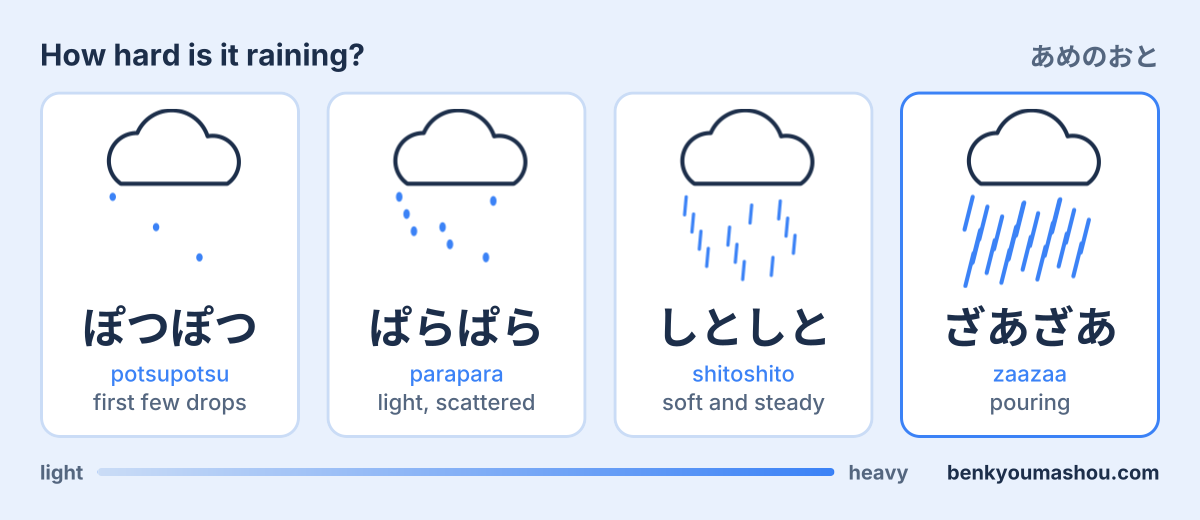
Weather is where most learners first notice how precise these words are. Japanese has a whole scale for rain alone, and weather reports and daily small talk use it freely.
| Word | Meaning | Example |
|---|---|---|
| ぽつぽつ | the first few drops | 雨がぽつぽつ降ってきた。 It's starting to spit with rain. |
| ぱらぱら | light, scattered rain | 雨がぱらぱらしている。 It's sprinkling. |
| しとしと | soft, steady, quiet rain | 雨がしとしと降っている。 A gentle rain is falling. |
| ザーザー | pouring, heavy rain | 雨がザーザー降っている。 It's pouring. |
| じめじめ | damp and humid | 梅雨はじめじめしている。 The rainy season is muggy. |
| からっと | dry and crisp (air, weather) | 今日はからっと晴れた。 It cleared up, dry and sunny. |
| ぽかぽか | pleasantly warm, sunny | ぽかぽかした春の日 a warm spring day |
| ひんやり | cool to the touch, chilly | 朝はひんやりしている。 The morning is chilly. |
| ビュービュー | strong wind blowing | 風がビュービュー吹いている。 The wind is howling. |
| ゴロゴロ | thunder rumbling | 雷がゴロゴロ鳴っている。 Thunder is rumbling. |
| ピカッ | a flash of lightning | 空がピカッと光った。 The sky flashed. |
| しんしん | snow falling silently; deep cold | 雪がしんしんと降る。 Snow falls silently. |
じめじめ is worth learning early if you live in Japan. From June into July, during the rainy season 梅雨, it is one of the most common small talk words in the country: じめじめしますね, "It's so muggy, isn't it." It is a perfect conversation opener with a neighbour or a coworker, because everyone agrees.
Your Body: Pain, Hunger and Tiredness
Back to the pharmacy. Describing how something feels in your body is where onomatopoeia stops being fun and becomes genuinely useful. Where English reaches for adjectives like throbbing, stinging or prickly, Japanese reaches for onomatopoeia. A doctor will often ask どんな痛みですか (What kind of pain is it?), and the natural answer is one of these words.
| Word | Kind of pain or feeling | Example |
|---|---|---|
| ズキズキ | throbbing, pulsing | 頭がズキズキします。 My head is throbbing. |
| ガンガン | pounding (head, often a hangover) | 頭がガンガンする。 My head is pounding. |
| チクチク | prickling, like needles | セーターがチクチクする。 This sweater is itchy and prickly. |
| ヒリヒリ | stinging, burning (sunburn, spicy food) | 日焼けで肩がヒリヒリする。 My shoulders sting from sunburn. |
| キリキリ | sharp, twisting (stomach, stress) | 胃がキリキリ痛む。 I have a sharp pain in my stomach. |
| ムカムカ | queasy, nauseous | 胸がムカムカする。 I feel sick. |
| ゾクゾク | chills, shivers | 背中がゾクゾクする。 I've got shivers down my back. |
| ふらふら | unsteady, light-headed | 熱でふらふらする。 I'm unsteady from the fever. |
And for the everyday states that are not quite pain:
お腹がぺこぺこだ。 Onaka ga pekopeko da. I'm starving.
のどがカラカラだ。 Nodo ga karakara da. My throat is parched.
今日はくたくただ。 Kyou wa kutakuta da. I'm worn out today.
昨日はぐっすり眠れた。 Kinou wa gussuri nemureta. I slept like a log last night.
授業中にうとうとしてしまった。 Jugyouchuu ni utouto shite shimatta. I nodded off in class.
Notice ムカムカ. It means queasy here, but the same word also describes rising anger: あの人の態度にムカムカする, "That person's attitude makes my blood boil." The feeling in your stomach and the feeling of anger share one word, which is a nice bridge into the next group.
Feelings
Gijougo, the words for feelings, are the ones textbooks underuse and native speakers overuse. Japanese conversation leans on them because they are softer and more vivid than naming the emotion outright. Saying 緊張しています (I am nervous) is accurate. Saying ドキドキしています sounds like a person talking.
| Word | Feeling | Example |
|---|---|---|
| ドキドキ | heart pounding: nerves, fear or a crush | 発表の前はドキドキする。 I get nervous before presentations. |
| ワクワク | excited anticipation | 旅行が楽しみでワクワクしている。 I'm excited about the trip. |
| ハラハラ | anxious, on the edge of your seat (watching others) | 試合を見ていてハラハラした。 The match had me on the edge of my seat. |
| イライラ | irritated, impatient | 電車が遅れてイライラする。 The late train is making me irritated. |
| モヤモヤ | uneasy, something unresolved | 言いたいことが言えなくて、モヤモヤする。 I couldn't say what I wanted, and it's bugging me. |
| ソワソワ | restless, fidgety, can't settle | 結果が気になってソワソワしている。 I'm restless waiting for the results. |
| ウキウキ | cheerful, in high spirits | 金曜日はみんなウキウキしている。 Everyone is in a good mood on Fridays. |
| ホッと | relieved (a breath out) | 無事に着いてホッとした。 I was relieved we arrived safely. |
| ガッカリ | disappointed | 試合に負けてガッカリした。 I was disappointed we lost. |
| ビクビク | jumpy, scared | 怒られるのではないかとビクビクしていた。 I was on edge, scared of being told off. |
The pair learners mix up most is ドキドキ and ワクワク. Both can come before something big, but ドキドキ is your heart racing, so it can be nerves, fear or attraction. ワクワク is pure looking forward to something; there is no fear in it. The night before a first date can be both, and Japanese people often say exactly that: ドキドキワクワク. ハラハラ is different again: it is the worry you feel while watching someone else, like a parent watching a child climb a tree.
If you want the plain vocabulary for emotions to go with these, our guide to emotions in Japanese covers the adjectives and verbs, and how to say them politely.
Food and Texture
Walk past a Japanese bakery or a convenience store shelf and you will see these words printed on packaging, because texture is one of the main things Japanese food is sold on. もちもち食感 (a chewy, mochi-like texture) on a bag of bread is a selling point, not a description of a flaw.
| Word | Texture | Typical food |
|---|---|---|
| ふわふわ | soft, fluffy, airy | pancakes, cake, omelette |
| もちもち | soft and chewy, springy | mochi, bagels, udon |
| サクサク | light and crisp, flaky | tempura, croissants, cookies |
| カリカリ | hard and crunchy | fried bacon, toast edges, nuts |
| パリパリ | thin and crisp, snapping | potato chips, nori, gyoza skins |
| シャキシャキ | crunchy and fresh | lettuce, cabbage, bean sprouts |
| とろとろ | melting, gooey | soft eggs, cheese, slow-cooked pork |
| ねばねば | sticky, stringy | natto, okra |
| プリプリ | firm and springy | shrimp, jelly |
| あつあつ | piping hot | ramen, takoyaki |
| ジュージュー | sizzling | yakiniku on the grill |
| ぐつぐつ | simmering, bubbling | hot pot, curry |
The three crunches are the ones to get right. サクサク is light and airy, like biting into tempura batter. カリカリ is harder, the crunch of something fried until firm. パリパリ is thin and snaps, like a sheet of nori. A Japanese speaker hearing サクサク and imagining nuts would find it slightly off, the way "crispy nuts" sounds a little wrong in English.
このとんかつは外がサクサクで、中がやわらかい。
Kono tonkatsu wa soto ga sakusaku de, naka ga yawarakai.
This tonkatsu is crisp outside and tender inside.
Food words are also the easiest place to start using onomatopoeia yourself. Say おいしい about everything and your Japanese sounds like a textbook. Say もちもちしていておいしい and it sounds like you actually ate it.
How People Move and Work
This group describes manner: how someone walks, works, talks or waits. These words often carry a judgement, good or bad, which makes them useful and a little dangerous.
| Word | Meaning | Tone |
|---|---|---|
| こつこつ | steadily, little by little | praise: patient effort |
| てきぱき | briskly, efficiently | praise |
| すらすら | smoothly, without getting stuck | praise: reading, answering |
| ぺらぺら | fluently (a language) | praise, though it can mean "chattering" |
| じっくり | carefully, taking time | neutral to positive |
| のんびり | relaxed, unhurried | positive, sometimes "too relaxed" |
| ぶらぶら | strolling around, aimless | neutral |
| うろうろ | wandering around, loitering | slightly negative, lost or suspicious |
| のろのろ | sluggishly, crawling | negative |
| ぐずぐず | dawdling, indecisive | negative |
| だらだら | lazily; dragging on too long | negative |
| ぼーっと | spaced out, absent-minded | negative or neutral |
| じっと | still, without moving; staring | neutral |
| じろじろ | staring rudely | negative |
毎日こつこつ勉強すれば、漢字も覚えられます。
Mainichi kotsukotsu benkyou sureba, kanji mo oboeraremasu.
Study a little every day and the kanji will come.
会議がだらだら続いている。
Kaigi ga daradara tsuzuite iru.
The meeting is dragging on and on.
ぺらぺら is the one every learner hopes to hear: 日本語がぺらぺらですね, "Your Japanese is so fluent." It is usually a polite encouragement rather than a test result, so take it kindly and keep going. Many of these words also work as plain adverbs, and our Japanese adverbs guide shows where they sit next to words like よく and すぐ.
Everyday Sounds: Animals, Doors and Machines
Finally, the true sound words, the giongo and giseigo. These are closest to English onomatopoeia, but the sounds themselves are not the same. A Japanese dog does not say woof.
| Sound | What makes it |
|---|---|
| ワンワン | a dog barking |
| ニャー | a cat |
| モー | a cow |
| コケコッコー | a rooster |
| チュンチュン | small birds, sparrows in the morning |
| ケロケロ | a frog |
| ミーンミーン | cicadas, the sound of a Japanese summer |
| ピンポン | a doorbell (also: correct answer!) |
| コンコン | knocking on a door |
| ガチャ | a lock or handle turning, a capsule toy machine |
| バタン | a door slamming |
| ピッ | a beep, like tapping a train card at the gate |
| チン | the microwave bell |
| パチパチ | applause; a fire crackling |
| ゲラゲラ | loud belly laughter |
| クスクス | giggling quietly |
Some of these have turned into ordinary words. チンする means to microwave something: お弁当をチンしてください, "Please heat up the bento." ガチャ, the sound of a capsule toy machine's handle turning, gave the machines their everyday name, ガチャガチャ, and later named the random prize draws in mobile games. And ピンポン, a doorbell, is also what a quiz show host says for a right answer, with ブッブー for a wrong one.
Hiragana or Katakana?
You may have noticed the same word written both ways: ドキドキ and どきどき, ザーザー and ざあざあ. There is no fixed rule, and both are correct. In practice:
- Katakana feels sharper, louder and more like a real sound. Manga sound effects are almost always katakana, and so are machine noises like ピッ.
- Hiragana feels softer and more descriptive. Novels and essays often write gitaigo like ふわふわ or しとしと in hiragana.
Katakana spelling also uses ー for long sounds where hiragana tends to write the vowel out, which is why you see ザーザー but ざあざあ. If katakana still slows you down, the katakana chart has every character with audio, and onomatopoeia is great practice for it.
Manga deserves a special mention, because it uses onomatopoeia for things English comics would never voice. ゴゴゴ is the low rumble of menace when a villain appears. And シーン is the sound of silence: a panel where nobody speaks, with シーン drawn across it, is one of the most familiar jokes in Japanese comics. If you read manga in Japanese, these effects are often the first words you recognise without a dictionary.
Which Ones Adults Say at Work
Onomatopoeia is not childish by default, but some of it is. A good rule of thumb is to look at what the word describes.
Words for manner and quality are fine almost anywhere, including polite speech at work: しっかり (properly, firmly), はっきり (clearly), じっくり (carefully), すっきり (refreshed, neat), きちんと (properly). You will hear a manager say じっくり検討します, "We will consider it carefully," in a meeting.
Words for feelings and body states are normal in conversation, polite or casual, but in formal writing you swap them for a plain word. ドキドキしました becomes 緊張しました in a report. お腹がぺこぺこです is warm and friendly with coworkers at lunch; you would not write it in an email to a client.
Some sound words used as nouns are baby talk. ワンワン for "a dog", ブーブー for "a car" and ポンポン for "tummy" are what parents say to toddlers. Use them only when you are being playful, or talking to a small child.
Try It Yourself
Pick the word that fits best. The answers are underneath.
- 朝から何も食べていないので、お腹が___です。 (I haven't eaten since morning, so I'm starving.)
- このパンは外がカリッとしていて、中は___です。 (This bread is crisp outside and fluffy inside.)
- 来週、初めて日本に行くので___しています。 (I'm going to Japan for the first time next week, and I can't wait.)
Answers: 1. ぺこぺこ. 2. ふわふわ (もちもち also works if the bread is chewy). 3. ワクワク. ドキドキ is possible too, but it adds nerves; ワクワク is pure excitement.
If you got all three, you already know the four slots: ぺこぺこ with です, ふわふわ with です, and ワクワク with する.
How to Make Them Stick
Lists like these are easy to read and easy to forget. A few habits make the difference.
Learn each word with its partner. Onomatopoeia almost always travels with the same verbs and nouns: 雨がザーザー降る, ぐっすり眠る, お腹がぺこぺこ, 頭がズキズキする. Learn the whole phrase, not the word alone, and you will be able to use it straight away.
Learn in pairs and shapes. Once you know ころころ, learn ごろごろ beside it. Once you know ドキドキ, notice ドキッ. The patterns from earlier in this guide do half the work for you.
Collect them by situation. Next time it rains, say the rain word out loud. When you eat something crunchy, decide whether it is サクサク, カリカリ or パリパリ. Tying a word to a moment you actually lived is the fastest way to keep it.
Read and listen for them. Manga, anime and easy reading material are full of onomatopoeia, used naturally. Our guide to easy Japanese reading has a list of places to start, and the Japanese vocabulary quiz is a quick way to test the words you already know.
Say them. These are spoken words first. Most of them are four even beats, ド・キ・ド・キ, and they only sound natural once that rhythm is in your mouth. Saying ドキドキしています to a real person once does more than reading it ten times. The Benkyou Mashou app gives you daily speaking practice, AI conversations where you can describe your day, flashcards for the phrases you want to keep, and short lessons, so words like ワクワク and くたくた end up in your mouth, not just your notes.