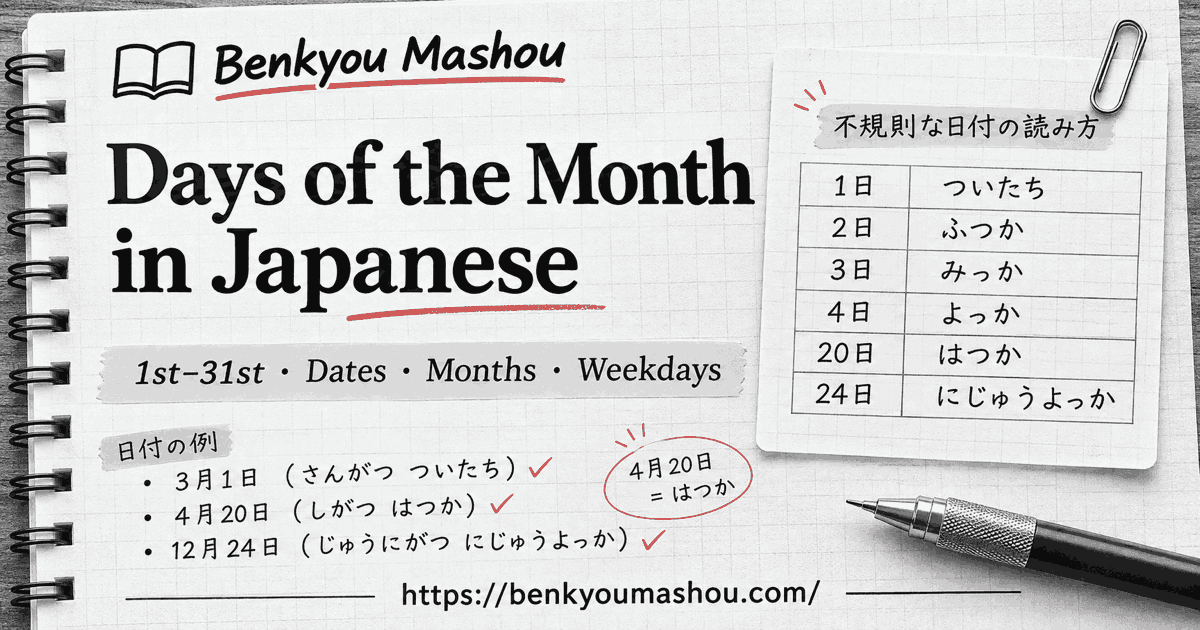
Why the First Ten Days Are Irregular
Most learners memorize ついたち through とおか as a list of exceptions. They are not really exceptions. They are the old native Japanese numbers, the same ones hiding inside ひとつ, ふたつ, みっつ, the counting you probably learned for objects.
Before Chinese numbers like いち, に, さん arrived, Japanese counted like this: ひ, ふ, み, よ, いつ, む, なな, や, ここの, とお. Put 日 (か, "day") after each one and you get almost exactly the date list:
| Old number |
+ か |
Date |
| ふ (2) |
ふつか |
2nd |
| み (3) |
みっか |
3rd |
| よ (4) |
よっか |
4th |
| いつ (5) |
いつか |
5th |
| む (6) |
むいか |
6th |
| なな (7) |
なのか |
7th |
| や (8) |
ようか |
8th |
| ここの (9) |
ここのか |
9th |
| とお (10) |
とおか |
10th |
If you already know the native numbers from counting things, you know most of the first ten days already. The sounds have worn down a little over the centuries (や became よう, む picked up an い), but the family resemblance is easy to hear once someone points it out.
The 20th, はつか, comes from the same system. はた was the old native word for twenty, and it survives in one other place every Japanese person knows: はたち (二十歳), the word for being twenty years old, the traditional age of becoming an adult.
The 1st is the odd one out, and this is where the moon comes in. Under the old lunar calendar, every month began on the new moon, when the moon was dark and a new cycle began. The first day was called つきたち, roughly "the moon rises" or "the month begins" (月立ち), and that was worn down into ついたち. In 1873 the months stopped following the moon, but the name for the 1st stayed.
The last day of the month has a moon-calendar name too. みそか (晦日) comes from みそ, the old word for thirty, because a lunar month ended on the 29th or 30th. You rarely hear it for an ordinary month now, but it survives in 大晦日 (おおみそか), New Year's Eve, the "big last day" of the year, even though December has 31 days.
The Four Groups That Make It Easy
Thirty-one separate words is a lot to learn. Four groups is not. This is how we suggest learning them, in this order:
- The regular majority. Number + にち. The 11th to 31st, except the 14th, 20th and 24th. If you can count to 31 in Japanese, you already have these.
- The old-number days: the 2nd to the 10th, and the 20th. Learn these as a set, out loud, in order: ふつか, みっか, よっか, いつか, むいか, なのか, ようか, ここのか, とおか. Then add はつか as "the twentieth, like はたち."
- The 4s: the 14th and 24th. These borrow よっか from the 4th: じゅうよっか, にじゅうよっか. Once you know よっか, there is nothing new here.
- The 1st. ついたち, the moon day. Only one word, and it has a story, which is the best memory aid there is.
The common mistake is mixing groups: saying じゅうよんにち for the 14th, or ふたにち for the 2nd. People will understand you, but it sounds as odd as "the twoth" does in English. Getting the 14th and 24th right is a small thing that quietly signals you learned properly.
A Date or a Number of Days?
Here is the part most charts leave out. The same kanji can be a date or a length of time, and for the first ten days the reading usually stays the same:
- 三日 (みっか) is "the 3rd" and "three days."
- 五日 (いつか) is "the 5th" and "five days."
- 二十日 (はつか) is "the 20th" and "twenty days."
Context tells you which one is meant. 三日に会いましょう is "let's meet on the 3rd." 三日かかります is "it takes three days." You can add 間 (かん) to make the length of time unmistakable: 三日間 (みっかかん), "for three days."
The one exception is 一日. Read ついたち, it is only ever the date, the 1st. "One day" as a length of time is いちにち. So 一日に来てください (ついたち) means "please come on the 1st," while 一日中 (いちにちじゅう) means "all day long." When you read 一日 on its own, the sentence around it decides the reading. If you want to see how a full sentence with dates is read, paste it into the kanji to hiragana converter.
Counting days uses the same words as dates, but counting months does not. "One month" is 一か月 (いっかげつ), with its own counter, not 一月, which means January. If counters in general feel slippery, our guide to Japanese counter words shows how 日 fits alongside 本, 枚 and the rest.
Months in Japanese
Months are the easy part. Japanese months have no names in everyday use; they are just numbers plus 月 (がつ, gatsu), "month."
| Month |
Kanji |
Hiragana |
Romaji |
| January |
一月 |
いちがつ |
ichigatsu |
| February |
二月 |
にがつ |
nigatsu |
| March |
三月 |
さんがつ |
sangatsu |
| April |
四月 |
しがつ |
shigatsu |
| May |
五月 |
ごがつ |
gogatsu |
| June |
六月 |
ろくがつ |
rokugatsu |
| July |
七月 |
しちがつ |
shichigatsu |
| August |
八月 |
はちがつ |
hachigatsu |
| September |
九月 |
くがつ |
kugatsu |
| October |
十月 |
じゅうがつ |
juugatsu |
| November |
十一月 |
じゅういちがつ |
juuichigatsu |
| December |
十二月 |
じゅうにがつ |
juunigatsu |
The only traps are the three in bold. April is しがつ, never よんがつ. July is しちがつ, never なながつ. September is くがつ, never きゅうがつ. These are fixed; there is no alternative reading to fall back on.
There is also an older set of month names from the lunar calendar, and you will meet them in poetry, letters, shop names and given names. 弥生 (やよい) is the third month and also a common woman's name. 皐月 (さつき) is the fifth month, which is why the two sisters in My Neighbor Totoro are Satsuki and Mei: both names mean May, one in old Japanese and one in English. 師走 (しわす), the twelfth month, still turns up in the news every December. The kanji read as "teachers running," and the popular explanation is that the end of the year is so busy even teachers and priests are rushing around. You do not need these to function in Japan, but they are a pleasant thing to recognize.
Days of the Week
The weekdays are where Japanese becomes surprisingly familiar. Each day is a celestial body plus 曜日 (ようび, youbi), "day of the week," and the order is the same one English and most of Europe use.
| Day |
Kanji |
Hiragana |
Romaji |
Named after |
| Sunday |
日曜日 |
にちようび |
nichiyoubi |
the sun (日) |
| Monday |
月曜日 |
げつようび |
getsuyoubi |
the moon (月) |
| Tuesday |
火曜日 |
かようび |
kayoubi |
Mars (火星, the fire star) |
| Wednesday |
水曜日 |
すいようび |
suiyoubi |
Mercury (水星, the water star) |
| Thursday |
木曜日 |
もくようび |
mokuyoubi |
Jupiter (木星, the wood star) |
| Friday |
金曜日 |
きんようび |
kin'youbi |
Venus (金星, the metal star) |
| Saturday |
土曜日 |
どようび |
doyoubi |
Saturn (土星, the earth star) |
English hides this a little, because Tuesday to Friday are named after Norse gods. But look at Spanish or French: martes (Mars), miércoles (Mercury), jueves (Jupiter), viernes (Venus). Japanese uses the very same planets in the very same order. Sunday is sun day in both languages, Monday is moon day, and Saturday is Saturn's day. If you speak a Romance language, you already know the logic of the Japanese week.
In speech and on calendars, people often drop 日 and say 月曜 (げつよう) or 金曜 (きんよう). On forms and calendars, the day is often just one kanji in brackets: (月), (火), (水). Many Japanese calendars start the week on Sunday, so 日 sits in the first column.
How to Write a Date in Japanese
Japanese writes dates from biggest to smallest: year, month, day, then the weekday. Each part carries its own unit.
2026年11月13日(金)
Read aloud: にせんにじゅうろくねん じゅういちがつ じゅうさんにち きんようび. If you have seen 年 in a guide to telling the time, the logic is the same as time: big unit first, small unit last.
You will see this shortened in a few common ways:
- 2026/11/13 or 2026.11.13 on receipts, tickets and food packaging.
- 11月13日 when the year is obvious.
- R8.11.13 or 令和8年11月13日 on official documents.
That last one is the Japanese era calendar. Japan counts years by imperial era as well as the Western year, and the current era, 令和 (れいわ, Reiwa), began in 2019. So 2019 is 令和元年 (the first year is called 元年, がんねん, not 1年), and 2026 is 令和8年. Banks, city offices, driving licences and many paper forms still use the era year, sometimes with no Western year at all. If you live in Japan you will eventually stand at a counter doing this subtraction in your head: Western year minus 2018 gives the Reiwa year.
When you write a birthday on a form, the same order applies: 1995年4月2日 for 2 April 1995. Writing it in English order (2/4/1995) is the classic way to be born on the wrong day in Japanese paperwork.
Asking and Talking About Dates
The question words follow the same pattern as the answers:
| Question |
Reading |
Meaning |
| 何日 |
なんにち |
which day of the month / how many days |
| 何月 |
なんがつ |
which month |
| 何曜日 |
なんようび |
which day of the week |
| 何年 |
なんねん |
which year / how many years |
| いつ |
itsu |
when |
A few sentences you will actually use:
- 今日は何日ですか。 What's the date today?
- 今日は十一月十三日です。 Today is November 13th.
- 誕生日はいつですか。 When is your birthday?
- 締め切りは何曜日ですか。 What day is the deadline?
- 来週の金曜日はどうですか。 How about next Friday?
Notice that いつ, "when," sounds exactly like いつか, the 5th, minus the か. They are not related in meaning, but the coincidence is a handy memory hook.
To talk about time relative to today, you need a small set of words. These are worth learning at the same time as the dates, because people use them more often than the dates themselves.
| Past |
Now |
Future |
| おととい (day before yesterday) |
|
あさって (day after tomorrow) |
| 昨日 きのう (yesterday) |
今日 きょう (today) |
明日 あした (tomorrow) |
| 先週 せんしゅう (last week) |
今週 こんしゅう (this week) |
来週 らいしゅう (next week) |
| 先月 せんげつ (last month) |
今月 こんげつ (this month) |
来月 らいげつ (next month) |
| 去年 きょねん (last year) |
今年 ことし (this year) |
来年 らいねん (next year) |
Two of these break their own pattern in the same way the dates do. 今日 is きょう and 今年 is ことし, not こんにち and こんねん, and 昨日 and 明日 have special readings too. Learn them as whole words.
Dates Every Japanese Person Knows
Some dates carry so much meaning that people refer to them by the date alone, and several of them sit on doubled odd numbers, an old tradition borrowed from China:
- 1月1日, 元日 (がんじつ). New Year's Day, the biggest holiday of the year. 元旦 (がんたん) strictly means the morning of the 1st, though many people use the two words loosely.
- 3月3日, ひな祭り. The Doll Festival, for girls.
- 5月5日, こどもの日. Children's Day, the last holiday of Golden Week.
- 7月7日, 七夕. The star festival, when people write wishes on paper strips and hang them on bamboo. Note the reading: the kanji say "seven evening," and the word is pure exception.
- 12月31日, 大晦日 (おおみそか). New Year's Eve, the last moon-calendar word still in daily use.
These are also good practice: reading 五月五日 as ごがついつか in one breath uses a month and an old-number day together, which is exactly the combination learners stumble on.
How to Make Them Stick
Say today's date every morning. It takes five seconds. 今日は十一月十三日、金曜日. Over a couple of months you will have said every day from the 1st to the 31st, in context, without a single flashcard. This works better than drilling the list because the irregular days arrive mixed in with the regular ones, the way you will meet them in real life.
Practice on paper. Put the printable dates chart next to your calendar or desk until the bold rows stop feeling strange. Covering the hiragana column and reading the kanji is a quick self-test.
Drill the counter, not just the list. Dates are one counter among many, and the same old-number readings show up when counting other things. Our free Japanese counter practice tool drills 日 alongside the other common counters, which is a good way to make sure よっか and ようか stop swapping places in your head.
Use them out loud. Dates are spoken constantly: making plans, booking things, talking about birthdays and deadlines. Knowing the chart and producing ここのか on the spot in a conversation are different skills. If you want practice saying them in real sentences, the speaking practice on Benkyou Mashou gives you conversations where dates and days come up naturally.
The days of the month look like a list of exceptions, but they are really a record of how Japan used to count and how it used to watch the moon. Learn the old numbers, remember that the 1st is the moon day and the 20th is the same はた as はたち, keep the 14th and 24th in their group, and the whole calendar falls into place.