Quick List: Famous Japanese Proverbs
| Proverb |
Literal meaning |
English equivalent |
| 猿も木から落ちる |
Even monkeys fall from trees |
Everyone makes mistakes |
| 石の上にも三年 |
Three years even on a stone |
Perseverance pays off |
| 七転び八起き |
Fall seven times, get up eight |
Never give up |
| 急がば回れ |
If you are in a hurry, go around |
More haste, less speed |
| 塵も積もれば山となる |
Even dust piled up becomes a mountain |
Every little bit helps |
| 猫に小判 |
Gold coins to a cat |
Pearls before swine |
| 花より団子 |
Dumplings over flowers |
Substance over show |
| 出る杭は打たれる |
The stake that sticks out gets hammered |
Don't stand out |
| 噂をすれば影がさす |
Talk about someone and their shadow appears |
Speak of the devil |
| 覆水盆に返らず |
Spilt water does not go back on the tray |
No use crying over spilt milk |
| 郷に入っては郷に従え |
In the village, follow the village |
When in Rome |
| 類は友を呼ぶ |
Like calls its friends |
Birds of a feather flock together |
| 住めば都 |
Wherever you live becomes the capital |
Home is where you make it |
| 井の中の蛙大海を知らず |
A frog in a well does not know the ocean |
Not knowing the wider world |
| 笑う門には福来る |
Luck comes to the gate where people laugh |
Laugh and the world laughs with you |
Each of these is explained below with an example.
Proverbs About Effort and Patience
Ishi no ue ni mo sannen: three years even on a stone
石の上にも三年. A cold stone gets warm if you sit on it for three years. Stick with something hard long enough and it pays off. People say this most often about a new job, and it is the classic advice to new graduates who want to quit in the first month.
新しい仕事はまだ大変だけど、石の上にも三年だと思って頑張っている。
The new job is still tough, but I'm sticking with it. Three years on a stone, as they say.
Chiri mo tsumoreba yama to naru: dust piles up into a mountain
塵も積もれば山となる. Small things add up. It works for savings, for study time, and for the dishes in the sink.
毎日百円ずつ貯金したら、一年で三万円以上になった。「塵も積もれば山となる」だね。
I saved 100 yen a day and had over 30,000 yen after a year. Dust really does pile up into a mountain.
The 積もれば here is the ば conditional, "if it piles up." If that form is new to you, the ba form grammar page explains it.
Nanakorobi yaoki: fall seven times, get up eight
七転び八起き. Keep getting back up, however many times you fall. The maths is deliberate: you get up once more than you fall, because you were standing at the start. Daruma dolls, which roll back upright when you push them over, are the picture everyone has in mind.
試験に二回落ちたけど、「七転び八起き」でまた受けるつもりだ。
I've failed the exam twice, but fall seven times, get up eight. I'm taking it again.
Senri no michi mo ippo kara: a thousand ri starts with one step
千里の道も一歩から. A ri was an old unit of distance of about four kilometres, so a thousand ri is a very long road. The saying comes from the Chinese classic of Laozi, and it is the same idea as "a journey of a thousand miles begins with a single step."
千里の道も一歩から。まずはひらがなを覚えよう。
A thousand ri starts with one step. Let's begin with hiragana.
Isogaba maware: if you are in a hurry, go around
急がば回れ. The safe long way is often faster than the risky shortcut. One popular explanation traces it to travellers crossing Lake Biwa: the boat across looked quicker, but the land route around the lake was the one that actually got you there when the wind was bad.
「急がば回れ」で、基本の文法からやり直した。
More haste, less speed. I went back and started again from basic grammar.
Proverbs About Failure and Mistakes
Saru mo ki kara ochiru: even monkeys fall from trees
猿も木から落ちる. Even experts slip up. It is usually kind, said to make someone feel better about a mistake in the thing they are good at. Saying it about yourself sounds a little proud, since it compares you to the monkey.
あの先生が漢字を間違えるなんて、「猿も木から落ちる」だね。
Even our teacher got a kanji wrong. Even monkeys fall from trees.
Koubou ni mo fude no ayamari: even Kobo makes a slip of the brush
弘法にも筆の誤り. Kobo Daishi, the monk Kukai, was one of the three great calligraphers of early Heian Japan. If even he could make a mistake with a brush, anyone can. Same meaning as the monkey, with more culture.
プロの通訳でも聞き間違えることはある。弘法にも筆の誤りだ。
Even professional interpreters mishear things. Even Kobo slipped with his brush.
Kappa no kawanagare: a kappa swept down the river
河童の川流れ. The kappa is a river creature from folklore and a brilliant swimmer, so a kappa being carried off by the current is the expert failing at their own speciality. Japanese has a whole set of these: the monkey, Kobo, the kappa. Pick whichever suits the mood.
料理が得意な母がケーキを焦がした。河童の川流れだね。
My mum, who is a great cook, burned the cake. A kappa swept away by the river.
Shippai wa seikou no moto: failure is the root of success
失敗は成功のもと. You learn more from the things that go wrong. This one is plain enough that teachers say it to children, and it is a good line to have ready when you are learning a language.
失敗は成功のもとだから、間違えても気にしないで。
Failure is the root of success, so don't worry about making mistakes.
Koukai saki ni tatazu: regret never comes first
後悔先に立たず. Regret always arrives after the event, never before, so act carefully now. People use it as a push to do something before it is too late.
後悔先に立たずと言うから、今のうちに勉強しておこう。
They say regret never comes first, so I'd better study while I can.
Fukusui bon ni kaerazu: spilt water does not return to the tray
覆水盆に返らず. What is done cannot be undone, especially words and broken relationships. The story behind it is Chinese: a wife who left her poor husband came back when he became rich, and he poured water on the ground and told her to put it back.
言ってしまった言葉は戻せない。「覆水盆に返らず」だ。
You can't take back what you said. Spilt water doesn't go back on the tray.
Proverbs About Luck and Timing
Inu mo arukeba bou ni ataru: a walking dog bumps into a stick
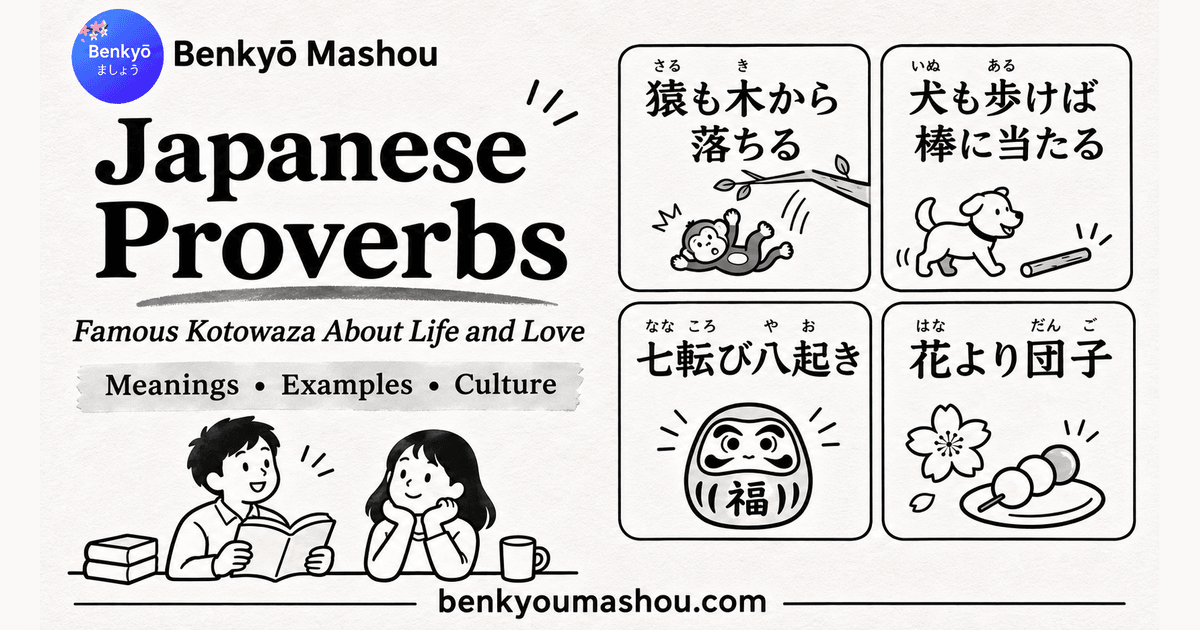
犬も歩けば棒に当たる. The card from the start of this guide. Most people now use it in the lucky sense: go out, try things, and something good will happen. You will still meet the older warning in books.
とりあえず外に出てみたら、昔の友達に会った。「犬も歩けば棒に当たる」ってことだね。
I went out without a plan and ran into an old friend. Get out there and luck finds you.
Warau kado ni wa fuku kitaru: luck comes to the laughing gate
笑う門には福来る. Good fortune visits homes full of laughter. It is a New Year favourite and shows up on cards and calligraphy. Note the reading: 来る is きたる here, an old reading you will mostly see in set phrases.
大変な時こそ笑おう。笑う門には福来るって言うでしょ。
Let's laugh especially when things are hard. Luck comes to the laughing gate, right?
Nokorimono ni wa fuku ga aru: there is luck in what is left
残り物には福がある. The last piece, the last choice, the leftover seat has its own luck. People say it at the table to get someone to take the last one, and to the person who had to pick last.
最後の一個、どうぞ。残り物には福があるよ。
Have the last one. There's luck in what's left.
Proverbs About People
Rui wa tomo wo yobu: like calls its friends
類は友を呼ぶ. Birds of a feather flock together. It can be neutral or a little pointed, depending on who you say it about.
彼の友達はみんなゲームが好きだ。類は友を呼ぶね。
All his friends love games. Birds of a feather.
Deru kui wa utareru: the stake that sticks out gets hammered
出る杭は打たれる. Usually translated "the nail that sticks out gets hammered down," but a 杭 is a wooden stake or post, the kind you drive into the ground in a row. The image is a fence line with one post too high. It describes the pressure to fit in, and people quote it both to explain that pressure and to complain about it. A newer reply goes 出すぎた杭は打たれない: a stake that sticks out far enough cannot be hammered.
会議であまり意見を言わないのは、出る杭は打たれると思っているからだ。
He doesn't say much in meetings because he thinks the stake that sticks out gets hammered.
Uwasa wo sureba kage ga sasu: speak of someone and their shadow appears
噂をすれば影がさす. Speak of the devil. In real conversation almost nobody says the whole thing. You say 噂をすれば and stop, the same way English speakers stop at "speak of the devil."
噂をすれば、田中さんが来たよ。
Speak of the devil, here's Tanaka.
Gou ni itte wa gou ni shitagae: in the village, follow the village
郷に入っては郷に従え. When in Rome, do as the Romans do. This is the one Japanese people will quote at you, kindly, about taking your shoes off or sorting the rubbish.
日本では家に入る前に靴を脱ぐ。「郷に入っては郷に従え」だ。
In Japan you take your shoes off before going into a house. When in Rome.
Shitashiki naka ni mo reigi ari: manners even between close friends
親しき仲にも礼儀あり. Even with family and close friends, keep basic courtesy. Pay back what you borrow, say thank you, knock.
「親しき仲にも礼儀あり」だから、借りたお金はすぐ返そう。
Manners matter even between friends, so pay back borrowed money right away.
Sumeba miyako: wherever you live becomes the capital
住めば都. Any place starts to feel like home once you live there. People who move to the countryside, or abroad, say it a lot.
最初は田舎が不便だと思ったけど、住めば都だ。
At first the countryside felt inconvenient, but wherever you live becomes the capital.
I no naka no kawazu taikai wo shirazu: a frog in a well
井の中の蛙大海を知らず. A frog in a well does not know the great ocean. Someone with a narrow view of the world, who thinks their small corner is everything. Most people say only the first half, 井の中の蛙. The 蛙 is read かわず, an old word for frog that survives in this proverb and in poetry.
留学して、自分が井の中の蛙だったと分かった。
Studying abroad showed me I'd been a frog in a well.
Proverbs About Love
Abata mo ekubo: pockmarks look like dimples
あばたもえくぼ (written 痘痕も靨, but almost always in kana). When you are in love, even someone's flaws look charming. It is affectionate and a little teasing.
彼女の遅刻癖もかわいいと言うなんて、「あばたもえくぼ」だね。
You think even her always being late is cute? Pockmarks look like dimples.
Koi wa moumoku: love is blind
恋は盲目. A direct translation of the English saying, and now completely at home in Japanese. Useful when a friend cannot see what everyone else can.
「恋は盲目」で、周りの意見が全然耳に入らない。
Love is blind. She doesn't hear a word anyone says.
En wa i na mono aji na mono: fate is strange and sweet
縁は異なもの味なもの. The ties that bring people together are mysterious and wonderful. Wedding speeches love this one, especially for couples who met in some unlikely way.
二人は駅で傘を間違えて出会ったそうだ。「縁は異なもの味なもの」だね。
They met when they took each other's umbrellas at the station. Fate is strange and sweet.
Saru mono wa hibi ni utoshi: those who leave grow distant day by day
去る者は日々に疎し. Out of sight, out of mind. Said about long distance relationships and friends who move away.
遠距離恋愛は難しい。去る者は日々に疎しと言うからね。
Long distance is hard. Out of sight, out of mind, as they say.
Proverbs About Money and Value
Neko ni koban: gold coins to a cat
猫に小判. A koban was an oval gold coin from the Edo period. Give one to a cat and it means nothing to it. Something valuable is wasted on someone who cannot appreciate it. Japanese also has 豚に真珠, "pearls to a pig," which comes straight from the Bible (Matthew 7:6), but the cat is the local version.
漢字が読めない私に書道の本をくれても、猫に小判だよ。
Giving me a calligraphy book when I can't read kanji is gold coins to a cat.
Hana yori dango: dumplings over flowers
花より団子. At cherry blossom season, plenty of people care more about the food than the flowers. It means choosing the practical over the beautiful, and it is almost always said with a smile.
桜を見に来たのに、弟は食べてばかりいる。花より団子だね。
We came to see the cherry blossoms and my brother is just eating. Dumplings over flowers.
Yasumonogai no zeni ushinai: buy cheap, lose money
安物買いの銭失い. The cheap version breaks and you pay twice. Every Japanese household has a story for this one.
安い傘を買ったら一週間で壊れた。「安物買いの銭失い」だった。
I bought a cheap umbrella and it broke in a week. Buy cheap, lose money.
Toki wa kane nari: time is money
時は金なり. This one was imported. It is Benjamin Franklin's "remember that time is money," from his 1748 advice to a young tradesman, put into classical Japanese. It sounds old because of the なり at the end, which is explained in the grammar section below.
Proverbs About Speaking and Caution
Kuchi wa wazawai no moto: the mouth is the source of trouble
口は災いの元. Careless words cause problems. A gentle warning before someone says something they will regret.
「口は災いの元」だから、上司の悪口は言わないほうがいい。
The mouth is the source of trouble, so don't badmouth the boss.
Iwanu ga hana: not saying is the flower
言わぬが花. Some things are better left unsaid. It is very Japanese in spirit, and also the perfect proverb for refusing to give spoilers.
結末は言わぬが花だから、自分で映画を見てね。
I won't tell you the ending. Some things are better unsaid, so go watch it.
Shiranu ga hotoke: not knowing is Buddha
知らぬが仏. Ignorance is bliss. If you do not know about a problem, you can stay as calm as a Buddha.
この料理のカロリーは知らぬが仏だよ。
Trust me, you don't want to know how many calories are in this.
Ishibashi wo tataite wataru: tap the stone bridge before crossing
石橋を叩いて渡る. A stone bridge is about as safe as bridges get, and this person still taps it to check. It describes someone very careful, sometimes too careful.
父は「石橋を叩いて渡る」タイプで、何でも三回確認する。
My dad is the type to tap a stone bridge before crossing. He checks everything three times.
Ame futte ji katamaru: after rain, the ground hardens
雨降って地固まる. A fight or a hard time can leave a relationship stronger than before, the way soil firms up after rain.
大げんかしたけど、「雨降って地固まる」で、前より仲良くなった。
We had a huge fight, but the ground hardens after rain. We're closer than before.
Proverbs That Argue With Each Other
English has "look before you leap" and "he who hesitates is lost." Japanese has the same problem, and knowing the pairs makes you sound fluent, because people love answering one proverb with its opposite.
| One side |
The other side |
| 二度あることは三度ある: what happens twice will happen a third time |
三度目の正直: literally "the third time is the honest one," meaning third time lucky |
| 急がば回れ: if you are in a hurry, take the long way |
善は急げ: do good things quickly |
| 石橋を叩いて渡る: check the bridge before crossing |
思い立ったが吉日: the day you decide is the lucky day |
| 蛙の子は蛙: a frog's child is a frog |
鳶が鷹を生む: a kite gave birth to a hawk (an ordinary family raises a star) |
So when a friend fails a driving test twice and says 二度あることは三度ある, the right reply is 三度目の正直だよ.
Proverbs Japanese People Get Wrong
Nasake wa hito no tame narazu
情けは人のためならず means "kindness is not only for the other person": be kind, and it comes back around to you. Many people read ためならず as "is not good for them" and take it to mean the opposite, that helping someone spoils them. In the Agency for Cultural Affairs' yearly survey on the Japanese language for 2010, 45.8% of people chose the correct meaning and 45.7% chose the opposite one. Among people in their twenties and thirties, the wrong reading was the more common.
The confusion is grammar. なり is an old form of だ, and ならず is its negative, "is not." So the proverb says "kindness is not (only) for others." It does not say "kindness is not good for others."
Inu mo arukeba bou ni ataru
As above, this has a warning reading and a lucky reading, and dictionaries list both. Neither is wrong, but if you use it in the lucky sense to an older speaker, do not be surprised if they look puzzled.
Korogaru ishi ni wa koke ga haenai
転がる石には苔が生えない, "a rolling stone gathers no moss," came into Japanese from English and brought both English readings with it. In the original British sense it is a criticism: someone who keeps changing jobs never builds anything up. In the American sense it is praise: someone who keeps moving stays fresh. Japanese dictionaries record both, so check which one the speaker means.
The Old Grammar Inside Proverbs
A lot of proverbs look odd to learners because they use classical Japanese. You do not need to study classical grammar, but four pieces cover almost every case:
| Old form |
Modern form |
Meaning |
In a proverb |
| ず |
ない |
not |
後悔先に立たず, 覆水盆に返らず |
| ぬ |
ない |
not |
言わぬが花, 知らぬが仏 |
| なり |
だ / である |
is |
時は金なり, 情けは人のためならず |
| 〜ば after the a sound |
〜えば |
if |
急がば回れ (= 急げば) |
The last one trips people up. In classical Japanese, ば attached to a different verb form than it does today, so 急がば is just old 急げば, "if you hurry." Modern ば forms like 積もれば and 住めば work exactly the way the ba form page and our guide to tara, ba, to and nara describe. The ず and ぬ endings are just the old negative, which you already know as the nai form.
The other pattern is も meaning "even": 猿も, 塵も, 犬も, 石の上にも. "Even monkeys," "even dust," "even a dog." If a proverb starts with a noun and も, it is almost always "even X," and the mo particle page covers that use.
How People Actually Use Them
In conversation, proverbs rarely arrive alone. They come wrapped in a few set frames:
| Frame |
Example |
Feel |
| 〜って言うでしょ |
笑う門には福来るって言うでしょ |
"you know what they say," casual |
| 〜と言うから |
後悔先に立たずと言うから |
"since they say," as a reason |
| 〜だね / 〜だよ |
花より団子だね (verb endings take quotes: 「猿も木から落ちる」だね) |
commenting on what just happened |
| まさに「〜」だ |
まさに「猿も木から落ちる」だね |
"a perfect case of" |
| 〜とはよく言ったものだ |
住めば都とはよく言ったものだ |
"they got that one right," reflective |
The quoting と in 〜と言う is the same one in the to quotation grammar page. Long proverbs also get cut down to their first half, like 噂をすれば and 井の中の蛙, and the listener fills in the rest.
One caution: proverbs can sound preachy. Quoting 石の上にも三年 at a coworker who is fed up with their job can land as a lecture. Most of the time people use them about something that already happened, as a wry comment, not as advice to someone else's face. Using them about yourself is always safe.
How to Learn Them
Do not memorise a list of a hundred. Learn the ten or fifteen in the quick list above first, because those are the ones in dramas, manga, variety shows and everyday talk. For each one, learn the situation as well as the meaning: you want to recognise the moment when someone would say it.
Three things help them stick. Learn them in their pairs and families (the monkey, Kobo and the kappa all mean the same thing). Say them in their frame, 〜って言うでしょ, instead of on their own. And read Japanese that is a little above your level, where they turn up naturally. Our guide on how to start easy Japanese reading is a good place to begin, and if you are studying for the JLPT, the N3 grammar list covers the patterns that sit around proverbs in real text.
The kanji in proverbs are often old or rare, like 塵, 杭 and 蛙, so do not let them hold you back. Learn the proverb by sound first and pick up the kanji later, the same way you would any word. Our guide on how to learn kanji has a method for that.
And if you want one proverb to carry through your studies, take 七転び八起き. Everyone learning Japanese falls over more than seven times. The point is the eighth.