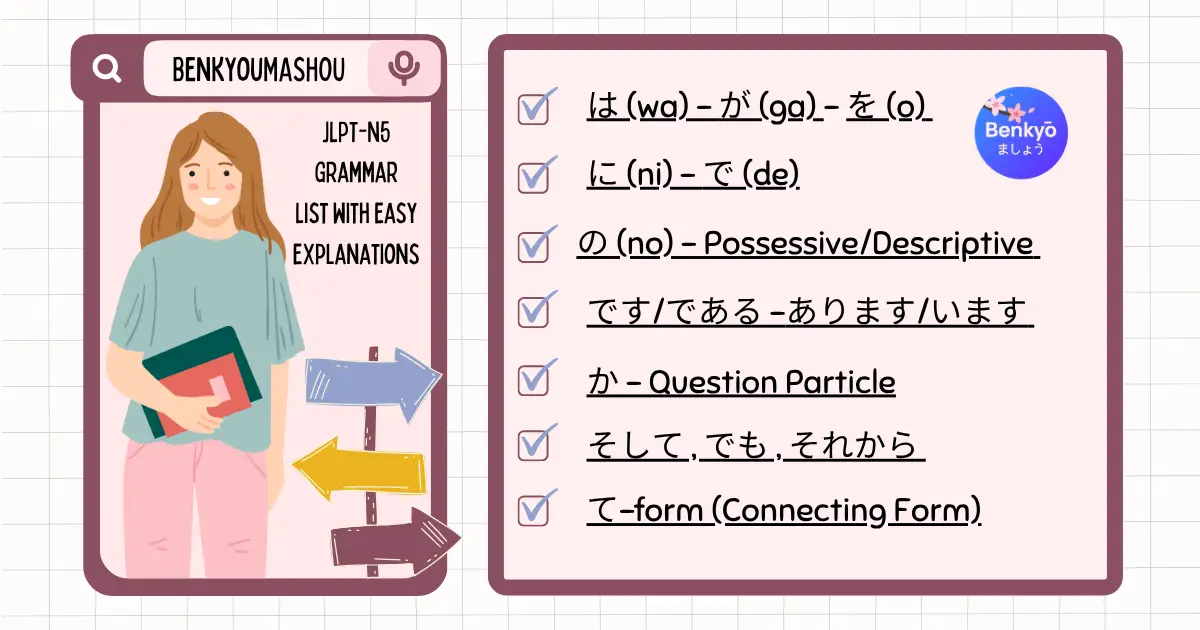
Studying for the JLPT N5? You're not alone. Most learners struggle with grammar — not because it's hard, but because it's rarely explained in a way that actually makes sense.
The truth? JLPT N5 grammar is your foundation. Master these 79 points and you'll be able to hold conversations, understand anime without subtitles, and pass the exam with confidence.
This covers all 79 N5 grammar points — the 25 you meet first in real depth, then every remaining point with its meaning, formation and a real example. Nothing on the N5 syllabus is left out.
Explore all N5 grammar lessons →
Table of Contents
- Why This Grammar List Will Transform Your Japanese
- How to Use This Guide
- Essential Particles (The Building Blocks)
- Core Sentence Structures
- Verb Conjugations You Must Know
- Time and Frequency Expressions
- Question Formation
- Connecting Ideas
- Advanced N5 Points
- The Rest of N5, Point by Point
- Particles You Haven't Met Yet
- Adjectives in Full
- Verb Forms Beyond the Basics
- More Te-Form Uses
- Saying What You Want and Like
- Talking About People and Things
- Time, Order and Change
- Connecting and Explaining
- Common Mistakes and How to Avoid Them
- Ready to Master N5 Grammar?
- Deep Dive into Individual Grammar Points
Why This Grammar List Will Transform Your Japanese
Think of JLPT N5 grammar as your Japanese foundation. Without these basics, everything else crumbles. But here's what makes this different from other grammar lists: every point here appears in daily conversation.
These aren't just exam questions — they're grammar patterns you'll actually use to:
- Introduce yourself to Japanese colleagues
- Ask for directions in Shibuya
- Talk about your hobbies and plans
- Express what you like and dislike
Ready? Let's dive in.
How to Use This Guide
Each grammar point follows this structure:
- What it means (in plain English)
- How to form it (step-by-step)
- Real examples you'll actually use
- Common mistake to avoid
Don't try to memorize everything at once. Pick 2-3 points, practice them for a few days, then add more. Quality over quantity always wins.
Essential Particles (The Building Blocks)
1. は (wa) - Topic Particle
What it means: "As for..." or "Speaking of..."
How to use it: [Topic] は [Comment about topic]
Examples:
- 私は田中です (Watashi wa Tanaka desu) - "I am Tanaka"
- 今日は暑いです (Kyō wa atsui desu) - "Today is hot"
- この本は面白いです (Kono hon wa omoshiroi desu) - "This book is interesting"
Common mistake: Writing わ instead of は. Remember: the topic particle は is always written with hiragana は but pronounced "wa."
Full explanation: は particle — with 8 audio example sentences and a quiz.
2. が (ga) - Subject Particle
What it means: Marks the grammatical subject (who/what is doing the action)
How to use it: [Subject] が [Verb/Adjective]
Examples:
- 雨が降っています (Ame ga futte imasu) - "Rain is falling"
- 犬がいます (Inu ga imasu) - "There is a dog"
- 誰が来ますか?(Dare ga kimasu ka?) - "Who is coming?"
Common mistake: Confusing が with は. Use が when introducing new information or answering "who/what" questions.
Full explanation: が particle — with 8 audio example sentences and a quiz.
3. を (o) - Object Particle
What it means: Marks what receives the action (direct object)
How to use it: [Object] を [Action verb]
Examples:
- コーヒーを飲みます (Kōhii o nomimasu) - "I drink coffee"
- 本を読みます (Hon o yomimasu) - "I read books"
- 映画を見ます (Eiga o mimasu) - "I watch movies"
Common mistake: Using が instead of を for objects. Remember: を for things being acted upon.
Full explanation: を particle — with 8 audio example sentences and a quiz.
4. に (ni) - Direction/Time/Location Particle
What it means: "to," "at," "in," "on" (direction, specific time, location of existence)
How to use it: Various patterns depending on meaning
Examples:
- 学校に行きます (Gakkō ni ikimasu) - "I go to school"
- 7 時に起きます (Shichiji ni okimasu) - "I wake up at 7 o'clock"
- 机の上に本があります (Tsukue no ue ni hon ga arimasu) - "There's a book on the desk"
Common mistake: Using で instead of に for destinations. Use に for "going to" somewhere.
Full explanation: に particle — with 8 audio example sentences and a quiz.
5. で (de) - Location/Method Particle
What it means: Where an action takes place, or how something is done
How to use it: [Location/Method] で [Action]
Examples:
- レストランで食べます (Resutoran de tabemasu) - "I eat at a restaurant"
- 日本語で話します (Nihongo de hanashimasu) - "I speak in Japanese"
- 車で行きます (Kuruma de ikimasu) - "I go by car"
Common mistake: Using に instead of で for action locations. Remember: で for where you DO things.
Full explanation: で particle — with 8 audio example sentences and a quiz.
6. の (no) - Possessive/Descriptive Particle
What it means: Shows possession or describes/modifies nouns
How to use it: [Modifier] の [Modified noun]
Examples:
- 私の本 (Watashi no hon) - "My book"
- 日本の料理 (Nihon no ryōri) - "Japanese food"
- 先生の車 (Sensei no kuruma) - "Teacher's car"
Common mistake: Overusing の in long chains. Keep it simple: usually 2-3 の maximum.
Full explanation: の particle — with 8 audio example sentences and a quiz.
Core Sentence Structures
7. です/である - Copula (To Be)
What it means: "am," "is," "are"
How to use it: [Noun/Adjective] です (polite) / である (casual written)
Examples:
- 学生です (Gakusei desu) - "I am a student"
- きれいです (Kirei desu) - "It's pretty"
- 元気です (Genki desu) - "I'm fine/healthy"
Common mistake: Using です with i-adjectives incorrectly. Say 高いです (takai desu), not 高いですです.
Full explanation: です forms — with 8 audio example sentences and a quiz.
8. あります/います - Existence Verbs
What it means: "there is/are," "to exist," "to have"
How to use it:
- あります for inanimate objects
- います for animate beings
Examples:
- 机があります (Tsukue ga arimasu) - "There is a desk"
- 犬がいます (Inu ga imasu) - "There is a dog"
- 時間があります (Jikan ga arimasu) - "I have time"
Common mistake: Using います for objects or あります for people/animals.
Full explanation: あります・います — with 8 audio example sentences and a quiz.
9. Present Tense Verbs
What it means: Actions happening now or regularly
How to form it:
- う-verbs: Replace う with います
- る-verbs: Replace る with ます
Examples:
- 食べます (tabemasu) - "eat/will eat"
- 飲みます (nomimasu) - "drink/will drink"
- 行きます (ikimasu) - "go/will go"
Common mistake: Confusing う and る verbs. Memorize common ones by pattern.
Full explanation: ます form — with 8 audio example sentences and a quiz.
10. Past Tense Verbs
What it means: Actions that happened in the past
How to form it: Replace ます with ました
Examples:
- 食べました (tabemashita) - "ate"
- 行きました (ikimashita) - "went"
- 見ました (mimashita) - "saw/watched"
Common mistake: Forgetting to change present to past when talking about completed actions.
Full explanation: ました form — with 8 audio example sentences and a quiz.
11. Negative Present
What it means: Actions not happening now or regularly
How to form it: Replace ます with ません
Examples:
- 食べません (tabemasen) - "don't eat/won't eat"
- 行きません (ikimasen) - "don't go/won't go"
- 分かりません (wakarimasen) - "don't understand"
Common mistake: Using じゃありません for verbs. That's only for です sentences.
Full explanation: ません form — with 8 audio example sentences and a quiz.
12. Negative Past
What it means: Actions that didn't happen in the past
How to form it: Replace ます with ませんでした
Examples:
- 食べませんでした (tabemasendeshita) - "didn't eat"
- 行きませんでした (ikimasendeshita) - "didn't go"
- 見ませんでした (mimasendeshita) - "didn't see/watch"
Common mistake: Using ませんだった instead of ませんでした.
Full explanation: ませんでした form — with 8 audio example sentences and a quiz.
Verb Conjugations You Must Know
13. て-form (Connecting Form)
What it means: Connects verbs, makes requests, shows ongoing actions
How to form it:
- Complex rules, but essential patterns:
- 食べて (tabete) from 食べる
- 行って (itte) from 行く
- 読んで (yonde) from 読む
Examples:
- 食べてください (Tabete kudasai) - "Please eat"
- 食べています (Tabete imasu) - "I am eating"
- 食べてから、映画を見ます (Tabete kara, eiga o mimasu) - "After eating, I watch a movie"
Common mistake: Memorizing て-form rules takes time. Focus on common verbs first.
Full explanation: て form — with 8 audio example sentences and a quiz.
14. ~ている (Present Progressive/State)
What it means: Ongoing actions or current states
How to form it: て-form + います
Examples:
- 食べています (Tabete imasu) - "I am eating"
- 住んでいます (Sunde imasu) - "I live (am living)"
- 知っています (Shitte imasu) - "I know"
Common mistake: Using simple present instead of ~ている for ongoing states like "living somewhere."
Full explanation: ている — with 8 audio example sentences and a quiz.
15. ~たい (Want to)
What it means: Express desires and wants
How to form it: Replace ます with たい
Examples:
- 食べたいです (Tabetai desu) - "I want to eat"
- 行きたくないです (Ikitakunai desu) - "I don't want to go"
- 映画を見たかったです (Eiga o mitakatta desu) - "I wanted to watch a movie"
We dive deep into this grammar pattern in our complete guide to the たい form – check it out for advanced usage tips and cultural insights!
Time and Frequency Expressions
16. Time Expressions with に
What it means: Specific times when things happen
How to use it: [Specific time] に
Examples:
- 6 時に起きます (Rokuji ni okimasu) - "I wake up at 6 o'clock"
- 月曜日に会議があります (Getsuyōbi ni kaigi ga arimasu) - "There's a meeting on Monday"
- 来年に日本に行きます (Rainen ni Nihon ni ikimasu) - "I'm going to Japan next year"
Common mistake: Using に with relative time words like 今日 (today) or 明日 (tomorrow). Say 今日行きます, not 今日に行きます.
Full explanation: に particle — with 8 audio example sentences and a quiz.
Full explanation: たい form — with 8 audio example sentences and a quiz.
17. から (from/since) and まで (until/to)
What it means: Starting and ending points in time or space
How to use it:
- [Start point] から
- [End point] まで
- [Start] から [End] まで
Examples:
- 9 時から働きます (Kuji kara hatarakimasu) - "I work from 9 o'clock"
- 5 時まで勉強します (Goji made benkyō shimasu) - "I study until 5 o'clock"
- 月曜日から金曜日まで学校があります (Getsuyōbi kara kin'yōbi made gakkō ga arimasu) - "There's school from Monday to Friday"
Common mistake: Forgetting まで when you mean "from X to Y" - include both から and まで.
Full explanation: から〜まで — with 8 audio example sentences and a quiz.
18. Frequency Adverbs
What it means: How often things happen
Common ones:
- いつも (itsumo) - always
- よく (yoku) - often
- ときどき (tokidoki) - sometimes
- あまり + negative (amari) - not very often
- 全然 + negative (zenzen) - never/not at all
Examples:
- いつもコーヒーを飲みます (Itsumo kōhii o nomimasu) - "I always drink coffee"
- あまりテレビを見ません (Amari terebi o mimasen) - "I don't watch TV very often"
- 全然分かりません (Zenzen wakarimasen) - "I don't understand at all"
Common mistake: Using あまり or 全然 without negative verbs.
Full explanation: common adverbs — with 8 audio example sentences and a quiz.
Question Formation
19. か - Question Particle
What it means: Turns statements into yes/no questions
How to use it: [Statement] + か
Examples:
- 学生ですか? (Gakusei desu ka?) - "Are you a student?"
- 映画を見ますか? (Eiga o mimasu ka?) - "Do you watch movies?"
- おいしかったですか? (Oishikatta desu ka?) - "Was it delicious?"
Common mistake: Forgetting か at the end of questions in formal speech.
Full explanation: か particle — with 8 audio example sentences and a quiz.
20. Question Words
What it means: Ask for specific information
Common question words:
- 何 (nani/nan) - what
- 誰 (dare) - who
- どこ (doko) - where
- いつ (itsu) - when
- どう/どうですか (dō/dō desu ka) - how
- どれ (dore) - which one
- いくら (ikura) - how much
- いくつ (ikutsu) - how many/how old
Examples:
- 何を食べますか? (Nani o tabemasu ka?) - "What do you eat?"
- どこに住んでいますか? (Doko ni sunde imasu ka?) - "Where do you live?"
- いくらですか? (Ikura desu ka?) - "How much is it?"
Common mistake: Using なん vs 何 incorrectly. Use なん before だ/です and counters.
Full explanation: question words — with 8 audio example sentences and a quiz.
Connecting Ideas
21. そして (and then), でも (but), それから (after that)
What it means: Connect sentences and ideas
How to use them:
- そして - adds information or sequence
- でも - shows contrast
- それから - shows sequence/time
Examples:
- 朝ご飯を食べます。そして、学校に行きます。(I eat breakfast. And then, I go to school.)
- 日本語は難しいです。でも、面白いです。(Japanese is difficult. But it's interesting.)
- 宿題をします。それから、テレビを見ます。(I do homework. After that, I watch TV.)
Common mistake: Starting sentences with these connectors too frequently. Vary your sentence patterns.
Full explanation: connecting with て — with 8 audio example sentences and a quiz.
22. ~と (when/if, and, with)
What it means: Multiple meanings depending on context
How to use it:
- Conditional: [Condition] と [Result]
- "And" with nouns: [Noun] と [Noun]
- "With": [Person] と [Action]
Examples:
- 雨が降ると、家にいます (Ame ga furu to, ie ni imasu) - "When it rains, I stay home"
- りんごとオレンジを買います (Ringo to orenji o kaimasu) - "I buy apples and oranges"
- 友達と映画を見ます (Tomodachi to eiga o mimasu) - "I watch movies with friends"
Common mistake: Overusing と for complex conditionals. Keep it simple at N5 level.
Full explanation: と particle — with 8 audio example sentences and a quiz.
Advanced N5 Points
23. Adjective Types and Conjugation
What it means: い-adjectives and な-adjectives behave differently
い-adjectives:
- Present: 高いです (takai desu) - "expensive"
- Past: 高かったです (takakatta desu) - "was expensive"
- Negative: 高くないです (takakunai desu) - "not expensive"
- Past negative: 高くなかったです (takakunakatta desu) - "wasn't expensive"
な-adjectives:
- Present: きれいです (kirei desu) - "pretty"
- Past: きれいでした (kirei deshita) - "was pretty"
- Negative: きれいじゃないです (kirei ja nai desu) - "not pretty"
- Past negative: きれいじゃなかったです (kirei ja nakatta desu) - "wasn't pretty"
Common mistake: Treating な-adjectives like い-adjectives. Remember: きれいでした, not きれいかったです.
Full explanation: い-adjectives — with 8 audio example sentences and a quiz.
24. ~ませんか (Invitations)
What it means: Polite invitations "Would you like to...?"
How to form it: Replace ます with ませんか
Examples:
- 一緒に映画を見ませんか? (Issho ni eiga o mimasen ka?) - "Would you like to watch a movie together?"
- コーヒーを飲みませんか? (Kōhii o nomimasen ka?) - "Would you like to drink coffee?"
- 今度、食事をしませんか? (Kondo, shokuji o shimasen ka?) - "Would you like to have a meal sometime?"
Common mistake: Using ませんか for offers you're making to yourself. Use ましょう instead.
Full explanation: ませんか — with 8 audio example sentences and a quiz.
25. ~ましょう (Let's)
What it means: Suggestions for group actions "Let's..."
How to form it: Replace ます with ましょう
Examples:
- 一緒に勉強しましょう (Issho ni benkyō shimashō) - "Let's study together"
- 映画を見ましょう (Eiga o mimashō) - "Let's watch a movie"
- 行きましょう (Ikimashō) - "Let's go"
Common mistake: Using ましょう when asking someone else to do something alone. Use ませんか for invitations.
Full explanation: ましょう — with 8 audio example sentences and a quiz.
The Rest of N5, Point by Point
The 25 above are the ones you meet first. Here is everything else on the N5 syllabus —
each with what it means, how to build it, and a real example. Every one links to a
full page with eight sentences you can listen to and a quiz.
Particles You Haven't Met Yet
も Particle (Also, Too, Both)
What it means: Also, too, both, neither, even
How to use it: [Noun] + も
Example: 田中さんも来るよ。 — "Tanaka is coming too."
Full explanation: も Particle (Also, Too, Both) — with 8 audio example sentences and a quiz.
へ Particle (Direction)
What it means: Toward, to (direction)
How to use it: [Destination] + へ
Example: 明日、大阪へ行きます。 — "I will go to Osaka tomorrow."
Full explanation: へ Particle (Direction) — with 8 audio example sentences and a quiz.
Listing Nouns
What it means: A and B (among other things) — non-exhaustive noun list
How to use it: Noun や Noun (や Noun…)
Example: 大阪で寿司やたこ焼きを食べました。 — "In Osaka, I ate sushi and takoyaki (among other things)."
Full explanation: Listing Nouns — with 8 audio example sentences and a quiz.
だけ
What it means: Only, just, no more than
How to use it: Noun / Verb [plain] / Adjective + だけ
Example: 水だけください。 — "Just water, please."
Full explanation: だけ — with 8 audio example sentences and a quiz.
くらい・ぐらい
What it means: About, approximately, to the extent of
How to use it: Quantity + くらい/ぐらい
Example: 三十分くらい待ちました。 — "I waited about thirty minutes."
Full explanation: くらい・ぐらい — with 8 audio example sentences and a quiz.
Adjectives in Full
Na-Adjectives
What it means: Descriptive words that need な before nouns
How to use it: な-adj + な + noun | な-adj + だ (plain) | な-adj + です (polite)
Example: 福岡はきれいです。 — "Fukuoka is beautiful."
Full explanation: Na-Adjectives — with 8 audio example sentences and a quiz.
Adjective Polite Present
What it means: It is ~ (polite present tense for adjectives)
How to use it: い-adj + です | な-adj + です
Example: 今日は暖かいです。 — "It's warm today."
Full explanation: Adjective Polite Present — with 8 audio example sentences and a quiz.
Adjective Polite Negative
What it means: It is not ~ (polite negative for adjectives)
How to use it: い-adj: drop い + くないです | な-adj + じゃありません
Example: 今日は暑くないです。 — "It's not hot today."
Full explanation: Adjective Polite Negative — with 8 audio example sentences and a quiz.
Adjective Polite Past
What it means: It was ~ (polite past tense for adjectives)
How to use it: い-adj: drop い + かったです | な-adj + でした
Example: 昨日は暑かったです。 — "It was hot yesterday."
Full explanation: Adjective Polite Past — with 8 audio example sentences and a quiz.
Adjective Polite Past Negative
What it means: It was not ~ (polite past negative for adjectives)
How to use it: い-adj: drop い + くなかったです | な-adj + じゃありませんでした
Example: 昨日は寒くなかったです。 — "It wasn't cold yesterday."
Full explanation: Adjective Polite Past Negative — with 8 audio example sentences and a quiz.
Adjective Plain Present
What it means: It is ~ (casual present tense for adjectives)
How to use it: い-adj as-is | な-adj + だ
Example: 今日、暑い。 — "It's hot today."
Full explanation: Adjective Plain Present — with 8 audio example sentences and a quiz.
Adjective Plain Negative
What it means: It is not ~ (casual negative for adjectives)
How to use it: い-adj: drop い + くない | な-adj + じゃない
Example: 今日は寒くない。 — "It's not cold today."
Full explanation: Adjective Plain Negative — with 8 audio example sentences and a quiz.
Adjective Plain Past
What it means: It was ~ (casual past tense for adjectives)
How to use it: い-adj: drop い + かった | な-adj + だった
Example: 昨日、楽しかった。 — "Yesterday was fun."
Full explanation: Adjective Plain Past — with 8 audio example sentences and a quiz.
Adjective Plain Past Negative
What it means: It was not ~ (casual past negative for adjectives)
How to use it: い-adj: drop い + くなかった | な-adj + じゃなかった
Example: あの映画、面白くなかった。 — "That movie wasn't interesting."
Full explanation: Adjective Plain Past Negative — with 8 audio example sentences and a quiz.
Adjective Te-Form
What it means: Connecting adjectives (~ and ~)
How to use it: い-adj: drop い + くて | な-adj + で
Example: 彼女は可愛くて頭がいい。 — "She's cute and smart."
Full explanation: Adjective Te-Form — with 8 audio example sentences and a quiz.
Adjectives as Adverbs
What it means: Turn adjectives into adverbs (quickly, quietly, etc.)
How to use it: い-adj: drop い + く | な-adj + に
Example: 早く起きてください。 — "Please wake up early."
Full explanation: Adjectives as Adverbs — with 8 audio example sentences and a quiz.
Describing Appearance
What it means: Describe someone's physical features (X has ~ eyes, ~ hair)
How to use it: Person は body-part が adjective
Example: 弟は髪が長いです。 — "My younger brother has long hair."
Full explanation: Describing Appearance — with 8 audio example sentences and a quiz.
Verb Forms Beyond the Basics
Japanese Verb Groups
What it means: Understanding the three verb groups and how Japanese verbs work
How to use it: U-verbs (Group I), Ru-verbs (Group II), Irregular verbs (Group III)
Example: 毎日コーヒーを飲む。 — "I drink coffee every day."
Full explanation: Japanese Verb Groups — with 8 audio example sentences and a quiz.
Verb Stems (i-form)
What it means: The base stem used to build polite forms and compound verbs
How to use it: U-verbs: う→い row | Ru-verbs: drop る | する→し, くる→き
Example: 食べ始めましょう。 — "Let's start eating."
Full explanation: Verb Stems (i-form) — with 8 audio example sentences and a quiz.
Dictionary Form
What it means: Plain/casual present-future affirmative form of verbs
How to use it: The base form of the verb as found in dictionaries
Example: 今日は何する? — "What are you doing today?"
Full explanation: Dictionary Form — with 8 audio example sentences and a quiz.
Plain Form Overview
What it means: The casual/informal verb system used among friends and in subordinate clauses
How to use it: Non-past aff: dictionary form | Non-past neg: nai-form | Past aff: ta-form | Past neg: nakatta-form
Example: 今日何する? — "What are you doing today?"
Full explanation: Plain Form Overview — with 8 audio example sentences and a quiz.
How to Convert Dictionary Form to Masu Form
What it means: Converting plain verbs to polite form
How to use it: Change う-row to い-row + ます (u-verbs) | Drop る + ます (ru-verbs)
Example: 毎日日本語を勉強します。 — "I study Japanese every day. (する → します)"
Full explanation: How to Convert Dictionary Form to Masu Form — with 8 audio example sentences and a quiz.
ない Form
What it means: Plain negative form — 'do not do' / 'will not do'
How to use it: Verb stem change + ない
Example: 今日はどこにも行かない。 — "I'm not going anywhere today."
Full explanation: ない Form — with 8 audio example sentences and a quiz.
なかった Form
What it means: Plain past negative — 'did not do ~'
How to use it: Nai-form stem + なかった
Example: 昨日どこにも行かなかった。 — "I didn't go anywhere yesterday."
Full explanation: なかった Form — with 8 audio example sentences and a quiz.
た Form
What it means: Plain past affirmative — 'did ~'
How to use it: Conjugation mirrors te-form but ends in た/だ instead of て/で
Example: 昨日映画を見た。 — "I watched a movie yesterday."
Full explanation: た Form — with 8 audio example sentences and a quiz.
に行く
What it means: Go / come in order to do ~
How to use it: Verb [ます stem] + に + 行く/来る/帰る | Noun + に + 行く
Example: 図書館に本を借りに行きます。 — "I'm going to the library to borrow a book."
Full explanation: に行く — with 8 audio example sentences and a quiz.
できます
What it means: Can do ~, able to ~ (polite potential)
How to use it: Verb dictionary form + ことができます | Noun + ができます
Example: 日本語を話すことができますか? — "Can you speak Japanese?"
Full explanation: できます — with 8 audio example sentences and a quiz.
More Te-Form Uses
て-Form Linking
What it means: Do A, then B: connecting sequential actions
How to use it: Verb [て-form] + Verb [て-form] + ... + final verb
Example: テニスをして、映画を見て、日本酒を飲んだ。 — "Played tennis, watched a movie, then drank sake."
Full explanation: て-Form Linking — with 8 audio example sentences and a quiz.
てください
What it means: Please do ~, Please don't ~
How to use it: Verb [て-form] + ください | Verb [ない-form] + でください
Example: ちょっと待ってください。 — "Please wait a moment."
Full explanation: てください — with 8 audio example sentences and a quiz.
てもいい
What it means: May I ~?, It's OK to ~, You must not ~
How to use it: Verb [て-form] + もいいですか / はいけません
Example: 写真を撮ってもいいですか? — "May I take a photo?"
Full explanation: てもいい — with 8 audio example sentences and a quiz.
てはいけない
What it means: Must not ~, may not ~
How to use it: Verb [て-form] + はいけない/はいけません
Example: ここで写真を撮ってはいけません。 — "You must not take photographs here."
Full explanation: てはいけない — with 8 audio example sentences and a quiz.
ないで
What it means: Without doing ~, don't do ~
How to use it: Verb [ない-form] + で
Example: 何も言わないで帰った。 — "He left without saying anything."
Full explanation: ないで — with 8 audio example sentences and a quiz.
てから
What it means: After doing ~
How to use it: Verb [て-form] + から
Example: 彼が来てから出発します。 — "We'll set off after he arrives."
Full explanation: てから — with 8 audio example sentences and a quiz.
Listing Actions
What it means: Do things like ~ and ~ (non-exhaustive list of actions)
How to use it: Verb ta-form + り … Verb ta-form + り + する
Example: 私たちは歌ったり踊ったりしました。 — "We sang and danced (among other things)."
Full explanation: Listing Actions — with 8 audio example sentences and a quiz.
Saying What You Want and Like
ほしい
What it means: Want (a thing)
How to use it: Noun + が + ほしい
Example: 新しいスマホがほしいです。 — "I want a new smartphone."
Full explanation: ほしい — with 8 audio example sentences and a quiz.
好き・嫌い
What it means: Like / dislike — adjectives, not verbs
How to use it: Topic は + Object が + 好き/嫌い + です
Example: 私は日本の音楽が好きです。 — "I like Japanese music."
Full explanation: 好き・嫌い — with 8 audio example sentences and a quiz.
のが上手・下手
What it means: Good at / bad at doing something
How to use it: Verb [plain] + のが + 上手/下手 | Noun + が + 上手/下手
Example: 彼はテニスが上手です。 — "He's good at tennis."
Full explanation: のが上手・下手 — with 8 audio example sentences and a quiz.
の
What it means: Turns a verb or clause into a noun
How to use it: Verb [plain form] + の
Example: 走るのが好きです。 — "I like running."
Full explanation: の — with 8 audio example sentences and a quiz.
Talking About People and Things
This & That
What it means: This one / that one / that one over there (standalone pronouns)
How to use it: これ (near me) | それ (near you) | あれ (far from both) | どれ (which?)
Example: これ何? — "What's this?"
Full explanation: This & That — with 8 audio example sentences and a quiz.
This / That + Noun
What it means: This ~, that ~, that ~ over there (before a noun)
How to use it: この + noun | その + noun | あの + noun | どの + noun?
Example: この文はチェックが必要です。 — "This sentence needs to be checked."
Full explanation: This / That + Noun — with 8 audio example sentences and a quiz.
ここ・そこ・あそこ
What it means: Here, there, over there
How to use it: ここ (near me) | そこ (near you) | あそこ (far from both) | どこ (where?)
Example: ここは静かですね。 — "It's quiet here, isn't it."
Full explanation: ここ・そこ・あそこ — with 8 audio example sentences and a quiz.
何か・何も
What it means: Something / nothing / someone / nowhere
How to use it: Question word + か (some) | Question word + も + negative (none)
Example: 何か飲みますか。 — "Would you like something to drink?"
Full explanation: 何か・何も — with 8 audio example sentences and a quiz.
あげる・くれる・もらう
What it means: Give and receive — direction decides the verb
How to use it: Giver は 受け手 に あげる/くれる | 受け手 は Giver に もらう
Example: 私は先生に本をもらいました。 — "I received a book from my teacher."
Full explanation: あげる・くれる・もらう — with 8 audio example sentences and a quiz.
Time, Order and Change
前に
What it means: Before ~
How to use it: Verb [dictionary form] + 前に | Noun + の + 前に
Example: 学校へ行く前に顔を洗いなさい。 — "Wash your face before you go to school."
Full explanation: 前に — with 8 audio example sentences and a quiz.
もう・まだ
What it means: Already / still / not yet
How to use it: もう + past or affirmative | まだ + affirmative or negative
Example: もう宿題をしました。 — "I've already done my homework."
Full explanation: もう・まだ — with 8 audio example sentences and a quiz.
なる
What it means: To become ~ (a change of state)
How to use it: い-adj: 〜く + なる | な-adj/Noun: 〜に + なる
Example: 天気がよくなりました。 — "The weather has got better."
Full explanation: なる — with 8 audio example sentences and a quiz.
一番
What it means: The most ~, the ~est
How to use it: (範囲)の中で + Noun + が + 一番 + Adjective
Example: 日本で一番高い山は富士山です。 — "The highest mountain in Japan is Mt Fuji."
Full explanation: 一番 — with 8 audio example sentences and a quiz.
Connecting and Explaining
Because
What it means: Because ~, so ~ (giving a reason)
How to use it: Sentence (plain/polite) + から
Example: 今日はとても忙しいから一緒に行けないの。 — "I can't go with you today because I'm very busy."
Full explanation: Because — with 8 audio example sentences and a quiz.
けど・が
What it means: But, however, although
How to use it: Sentence + けど / が + Sentence
Example: 高いけど、買います。 — "It's expensive, but I'll buy it."
Full explanation: けど・が — with 8 audio example sentences and a quiz.
と言う・と思う
What it means: Marks quoted speech and thought
How to use it: Plain form + と + 言う/思う | casual: って
Example: 明日は雨が降ると思います。 — "I think it will rain tomorrow."
Full explanation: と言う・と思う — with 8 audio example sentences and a quiz.
んです
What it means: Explanatory です — giving or seeking a reason
How to use it: Plain form + んです | な-adj/Noun + なんです
Example: 今日はちょっと忙しいんです。 — "I'm a bit busy today. (that's why)"
Full explanation: んです — with 8 audio example sentences and a quiz.
よ・ね
What it means: よ tells, ね seeks agreement
How to use it: Sentence + よ | Sentence + ね | Sentence + よね
Example: 今日はいい天気ですね。 — "Lovely weather today, isn't it."
Full explanation: よ・ね — with 8 audio example sentences and a quiz.
Japanese Word Order (SOV)
What it means: Subject-Object-Verb sentence structure
How to use it: [Topic]は + [Details] + [Verb]
Example: 姉は毎朝公園で走る。 — "My sister runs in the park every morning."
Full explanation: Japanese Word Order (SOV) — with 8 audio example sentences and a quiz.
Kana vs Kanji
What it means: The three Japanese scripts and when to use each
How to use it: Hiragana + Katakana + Kanji
Example: 私はコーヒーを飲みます。 — "I drink coffee. (kanji + katakana + hiragana in one sentence)"
Full explanation: Kana vs Kanji — with 8 audio example sentences and a quiz.
すぎる
What it means: Too ~, excessively ~
How to use it: Verb [ます stem] / い-adj [drop い] / な-adj + すぎる
Example: 値段が高すぎる! — "The price is too high!"
Full explanation: すぎる — with 8 audio example sentences and a quiz.
Common Mistakes and How to Avoid Them
The Big 5 N5 Grammar Mistakes
-
Particle confusion - Practice particle drills daily. Focus on は/が, に/で, and を/が distinctions.
-
Adjective conjugation errors - Make flashcards for い vs な adjective patterns.
-
Verb tense mixing - Pay attention to time markers in sentences.
-
Question formation - Practice turning statements into questions systematically.
-
Overcomplicating - N5 grammar should feel natural. If it's too complex, you're probably overthinking it.
Quick Practice Tips
Focus on quality over quantity – master 2-3 grammar points completely before moving on. Here's what works:
Daily (just 10 minutes):
- Pick 3 grammar points from this list
- Make 2 real-life example sentences with each
- Test yourself with flashcards or our app
Weekly check-in:
- Write a short paragraph using the week's grammar
- Identify your trouble spots and review them
The key? Use these patterns in context, don't just memorize rules. Every grammar point here appears in real conversations, so practice them the way you'd actually use them.
Ready to Master N5 Grammar?
These 25 grammar points form the foundation of Japanese communication. They're not just test questions – they're your toolkit for real conversations, understanding Japanese media, and expressing yourself naturally.
The key isn't memorizing every rule perfectly. It's understanding how these patterns work together to create meaning. Start with the basics, practice daily, and before you know it, these grammar structures will feel as natural as English.
Remember: every advanced Japanese speaker started exactly where you are now. These fundamentals got them there, and they'll get you there too.
頑張って!(Ganbatte! - You've got this!)
Ready to practice? Try our interactive grammar exercises in the Benkyou Mashou app, where you can test your knowledge with real JLPT N5 questions and track your progress.
Deep Dive into Individual Grammar Points
Want detailed explanations with practice questions? Check our dedicated grammar guides: